
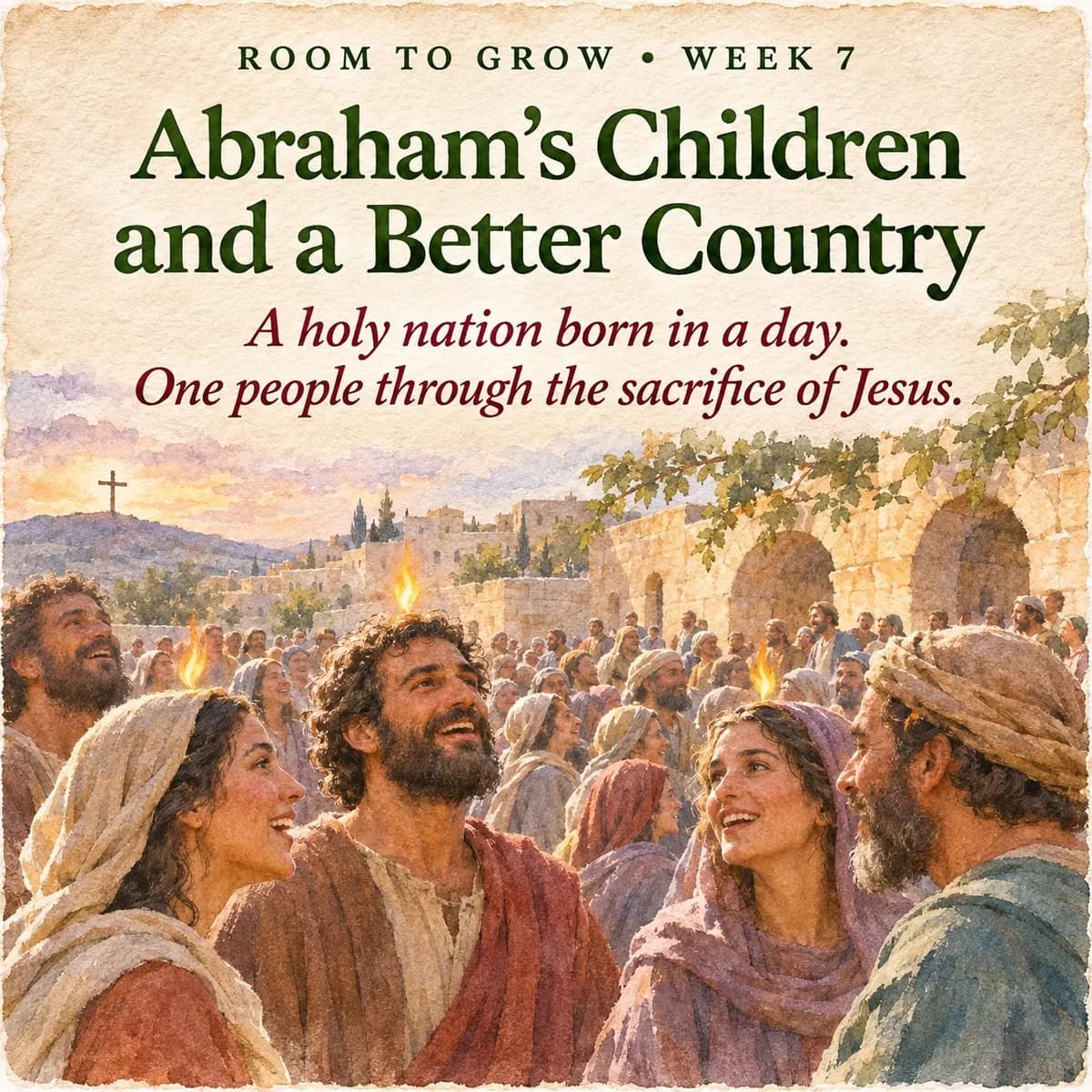
Room To Grow • A Tried & True Series
Week 7
Abraham's Children and a Better Country
By Trish Tipton
If you're back, it's because you're looking for answers too. Let's dive in and search together. If the covenant is fulfilled in Christ, who are Abraham's children now? And what was the land pointing to?
In the first week we looked at that fulfilled covenant, and at how Jesus made one new people in one body through the cross. There is neither Jew nor Greek. I don't want to walk through all of that again. This week asks what that means for the land, for the modern state founded in 1948, and for a better country that Hebrews calls heavenly.
None of this is against Jewish people. Jesus Himself was a Jew, and so were His apostles. Any Jewish person who comes to Christ is as much a child of Abraham as ever. I wish nothing but good for Jewish people, in Israel and everywhere else. I need to say that before we go any further, because these questions get tangled up with politics very quickly, and I don't want kindness to get lost.
God promised Abraham descendants, and a land, and that all the families of the earth would be blessed through him:
Genesis 12:1-3 (NASB 2020)
1Now the LORD said to Abram, “Go from your country, And from your relatives And from your father’s house, To the land which I will show you; 2And I will make you into a great nation, And I will bless you, And make your name great; And you shall be a blessing; 3And I will bless those who bless you, And the one who curses you I will curse. And in you all the families of the earth will be blessed.”
Notice who God is talking to. "Now the LORD said to Abram." The "you" is Abram, one man, called out of his country. "I will bless those who bless you." And look at the end: "In you all the families of the earth will be blessed." From the very beginning, the promise was meant to reach every family on earth.
Paul tells us how that promise is fulfilled:
Galatians 3:16 (NASB 2020)
16Now the promises were spoken to Abraham and to his seed. He does not say, “And to seeds,” as one would in referring to many, but rather as in referring to one, “And to your seed,” that is, Christ.
"To your seed," that is, Christ. The promises pointed to one person: Jesus. And Paul tells us who shares in them:
Galatians 3:7 (NASB 2020)
7Therefore, recognize that it is those who are of faith who are sons of Abraham.
Galatians 3:29 (NASB 2020)
29And if you belong to Christ, then you are Abraham’s descendants, heirs according to promise.
"Those who are of faith" are sons of Abraham. "If you belong to Christ, then you are Abraham's descendants, heirs according to promise." That is the line I keep coming back to. In the first week I said a Gentile hairstylist from Tulsa is included in that family. I still read it that way. We're one family, by faith.
Paul said it another way in Romans:
Romans 4:13, 16-17 (NASB 2020)
13For the promise to Abraham or to his descendants that he would be heir of the world was not through the Law, but through the righteousness of faith. 16For this reason it is by faith, in order that it may be in accordance with grace, so that the promise will be guaranteed to all the descendants, not only to those who are of the Law, but also to those who are of the faith of Abraham, who is the father of us all, 17(as it is written: “I HAVE MADE YOU A FATHER OF MANY NATIONS”) in the presence of Him whom he believed, that is, God, who gives life to the dead and calls into being things that do not exist.
The promise is guaranteed to all the descendants, not only to those who are of the Law, but also to those who are of the faith of Abraham, "who is the father of us all." God made him "a father of many nations."
And this:
Romans 2:28-29 (NASB 2020)
28For he is not a Jew who is one outwardly, nor is circumcision that which is outward in the flesh. 29But he is a Jew who is one inwardly; and circumcision is of the heart, by the Spirit, not by the letter; and his praise is not from people, but from God.
A Jew "inwardly," with circumcision "of the heart, by the Spirit." Then later in the same letter:
Romans 9:6-8 (NASB 2020)
6But it is not as though the word of God has failed. For they are not all Israel who are descended from Israel; 7nor are they all children because they are Abraham’s descendants, but: “THROUGH ISAAC YOUR DESCENDANTS SHALL BE NAMED.” 8That is, it is not the children of the flesh who are children of God, but the children of the promise are regarded as descendants.
"They are not all Israel who are descended from Israel." "It is not the children of the flesh who are children of God, but the children of the promise are regarded as descendants." Paul, a Jew himself, is saying God's Israel was never just about bloodline. It was about God's promise.
Jesus made the same kind of distinction when people claimed Abraham as their father:
John 8:39 (NASB 2020)
39They answered and said to Him, “Abraham is our father.” Jesus *said to them, “If you are Abraham’s children, do the deeds of Abraham.
"If you are Abraham's children, do the deeds of Abraham." Belonging is not only a name we inherit. It shows up in a life that looks like his faith.
So who are Abraham's children now? The way I read it, everyone who belongs to Christ by faith, Jew and Gentile alike. When Christ came, He took what was a physical nation and opened a spiritual one, the body of Christ. All are invited in.
That still leaves the land. Here is the promise God made to Abram:
Genesis 15:18-21 (NASB 2020)
18On that day the LORD made a covenant with Abram, saying, “To your descendants I have given this land, From the river of Egypt as far as the great river, the river Euphrates: 19the land of the Kenite, the Kenizzite, the Kadmonite, 20the Hittite, the Perizzite, the Rephaim, 21the Amorite, the Canaanite, the Girgashite, and the Jebusite.”
Some teach that this land promise is still waiting to be fulfilled. I wanted to see what the Bible itself says happened to it.
There were two occasions when Moses brought water from a rock. The first time, God told him to strike it:
Exodus 17:5-6 (NASB 2020)
5Then the LORD said to Moses, “Pass before the people and take with you some of the elders of Israel; and take in your hand your staff with which you struck the Nile, and go. 6Behold, I will stand before you there on the rock at Horeb; and you shall strike the rock, and water will come out of it, so that the people may drink.” And Moses did so in the sight of the elders of Israel.
Later, in Numbers, God told him to speak to the rock. This time Moses struck it twice:
Numbers 20:10-12 (NASB 2020)
10and Moses and Aaron summoned the assembly in front of the rock. And he said to them, “Listen now, you rebels; shall we bring water for you out of this rock?” 11Then Moses raised his hand and struck the rock twice with his staff; and water came out abundantly, and the congregation and their livestock drank. 12But the LORD said to Moses and Aaron, “Since you did not trust in Me, to treat Me as holy in the sight of the sons of Israel, for that reason you shall not bring this assembly into the land which I have given them.”
"Shall we bring water?" And then he struck it twice, although God had told him to speak. I see Moses doing it his way, and God's own reason for the judgment was that Moses had not trusted Him or treated Him as holy. It wasn't that striking a rock was always wrong. Obedience mattered in what God told him that time. Moses was not allowed to lead the people into the land. Joshua was.
Moses wasn't the only one who didn't enter. After the people refused to trust God, this was the judgment on the numbered men twenty and older who had grumbled:
Numbers 14:29-30 (NASB 2020)
29your dead bodies will fall in this wilderness, all your numbered men according to your complete number from twenty years old and upward, who have grumbled against Me. 30By no means will you come into the land where I swore to settle you, except for Caleb the son of Jephunneh and Joshua the son of Nun.
Joshua and Caleb were the named exceptions. I don't want to make that wider than the verse does by turning it into a claim about every person of that age.
And then, after the land was divided among the tribes, here is what the Bible says:
Joshua 21:43-45 (NASB 2020)
43So the LORD gave Israel all the land which He had sworn to give to their fathers, and they took possession of it and lived in it. 44And the LORD gave them rest on every side, in accordance with everything that He had sworn to their fathers, and no one of all their enemies stood before them; the LORD handed all their enemies over to them. 45Not one of the good promises which the LORD had made to the house of Israel failed; everything came to pass.
"The LORD gave Israel all the land which He had sworn to give to their fathers." "Not one of the good promises which the LORD had made to the house of Israel failed; everything came to pass."
Joshua said it again himself, near the end of his life:
Joshua 23:14 (NASB 2020)
14“Now behold, today I am going the way of all the earth, and you know in all your hearts and in all your souls that not one word of all the good words which the LORD your God spoke concerning you has failed; they all have been fulfilled for you, not one of them has failed.
"Not one of them has failed." I know many sincere Christians read the land promises differently, and I respect them. But when Scripture says everything came to pass, I have to take it at its word. God had given Israel the land. When the people turned away afterward, I don't read that as the covenant starting over again and again.
And then what happened? Joshua died, and the people forgot quickly:
Judges 2:8-10 (NASB 2020)
8Then Joshua the son of Nun, the servant of the LORD, died at the age of 110. 9And they buried him in the territory of his inheritance in Timnath-heres, in the hill country of Ephraim, north of Mount Gaash. 10All that generation also were gathered to their fathers; and another generation rose up after them who did not know the LORD, nor even the work which He had done for Israel.
"Another generation rose up after them who did not know the LORD, nor even the work which He had done for Israel." Years ago I heard someone say we are one generation away from losing what the last generation knew. That comes back to me here. We cannot hand down living faith simply by assuming the next generation knows the story.
Hebrews tells us what Abraham himself was looking for, even while he lived in the land of promise:
Hebrews 11:8-10 (NASB 2020)
8By faith Abraham, when he was called, obeyed by going out to a place which he was to receive for an inheritance; and he left, not knowing where he was going. 9By faith he lived as a stranger in the land of promise, as in a foreign land, living in tents with Isaac and Jacob, fellow heirs of the same promise; 10for he was looking for the city which has foundations, whose architect and builder is God.
Hebrews 11:13-16 (NASB 2020)
13All these died in faith, without receiving the promises, but having seen and welcomed them from a distance, and having confessed that they were strangers and exiles on the earth. 14For those who say such things make it clear that they are seeking a country of their own. 15And indeed if they had been thinking of that country which they left, they would have had opportunity to return. 16But as it is, they desire a better country, that is, a heavenly one. Therefore God is not ashamed to be called their God; for He has prepared a city for them.
"A better country, that is, a heavenly one." Abraham lived in the promised land like a stranger, because he was looking for a city whose architect and builder is God.
So is that a better country physically, or a better place in eternity? Hebrews calls it heavenly, which points me beyond winning a piece of ground here. The way I read it, we belong to God now, while still waiting for the fullness of what He has promised. I don't have every detail worked out. But Abraham's looking forward keeps me looking beyond what I can hold in my hands.
And if all of us in Christ are Abraham's children through the fulfillment of the covenant in Jesus, isn't the land already ours wherever we live? That's my opinion, and I want to say it gently. I don't mean I have a deed to somebody else's home. I mean the promise has reached its fulfillment in Christ, and I don't have to take land from anyone to become His heir. We share the inheritance in Him now.
When I look at the struggle over land in the Middle East, I see what looks to me like a power-hungry land grab, not something Christ asked His followers to carry out. That's my opinion about power, not a judgment on Jewish people. I can wish Jewish and Palestinian neighbors peace, care about their safety, and still question what any government does.
I've also asked myself why so many Christians give unquestioning support to a government that does not share their confession of Christ. Are they hoping that support will win people over? I don't know their motives. I just don't think a political alliance can do the work of the gospel. Loving Jewish people is not the same as endorsing every political decision, any more than loving Americans means approving everything our government does.
This next part makes me sad. Not sad about the nation of Israel, and not sad about Jewish people. Sad that so many Christians believe "bless Israel and you'll be blessed," and that the belief gets used the way it does. I've heard it said as if it settles everything: support the modern nation, and God will bless you; question it, and you're under a curse. The words people quote are the ones we read in Genesis 12, spoken to Abram. Paul shows that promise fulfilled in Christ, Abraham's seed, so that all the families of the earth are blessed. I don't read it as a promise that God will bless people for supporting a modern nation's government. It turns a beautiful promise into a political test.
That raises a simpler question a lot of us were never invited to ask: is today's Israel the Israel of the Bible?
In the Torah, "Israel" is first a man. God renamed Jacob:
Genesis 35:10-12 (NASB 2020)
10God said to him, “Your name is Jacob; You shall no longer be called Jacob, But Israel shall be your name.” So He called him Israel. 11God also said to him, “I am God Almighty; Be fruitful and multiply; A nation and a multitude of nations shall come from you, And kings shall come from you. 12And the land which I gave to Abraham and Isaac, I will give to you, And I will give the land to your descendants after you.”
The people of Israel were Jacob's descendants, the twelve tribes, and God promised them the land.
The modern state of Israel was proclaimed on May 14, 1948, by David Ben-Gurion, and President Truman recognized it the same day. But it was a long road getting there: the British Balfour Declaration in 1917, years of British rule over Palestine, and a United Nations partition vote in November 1947 (Office of the Historian). I've heard it preached that Israel "was created in a day," as Bible prophecy foretold. The documents were signed in a day. The nation took decades in coming.
The verse usually quoted for a nation "born in one day" is in Isaiah's last chapter:
Isaiah 66:7-8 (NASB 2020)
7“Before she was in labor, she delivered; Before her pain came, she gave birth to a boy. 8Who has heard such a thing? Who has seen such things? Can a land be born in one day? Can a nation be given birth all at once? As soon as Zion was in labor, she also delivered her sons.
Read in its place, this is part of Isaiah's closing prophecy about Zion and her children. I don't see May 14, 1948 named there. Some Christians read it that way, and I understand why. The way I read it, that is taking a verse out of its setting.
But as I read it again, something struck me. In a way, a nation really was born in a day. Think about the day of Pentecost, when about three thousand people were added in one day (Acts 2:41). The death and resurrection of Jesus brought forth a whole new nation, neither Jew nor Greek. Peter writes to believers, "But you are A CHOSEN PEOPLE, A royal PRIESTHOOD, A HOLY NATION, A PEOPLE FOR GOD'S OWN POSSESSION" (1 Peter 2:9). Those are the words once spoken over Israel at Sinai. Paul calls those who walk by the new creation "the Israel of God" (Galatians 6:15-16).
That makes more sense to me than papers signed about 80 years ago, for a promise that still hasn't really come to pass, with people still trying to take possession of something I'm not sure exists the way they hope. I know some teachers still look for a future fulfillment for the Jewish people, and I respect that. But for me, the cross and the empty tomb are where that nation was born.
So the Israel of Genesis, the family of Jacob, and the modern nation founded in 1948 are not the same thing. People can talk about the modern nation's politics on their own terms. I just don't think we should take verses out of their setting and stamp them on today's headlines. If the modern state and the Israel of Scripture aren't interchangeable, then supporting a government isn't the same thing as being faithful to God. That's the distinction I want to leave with, not a verdict against a people.
Mixing the old covenant with the new did not stop at the tithe. It also shaped how many of us read Israel and the land. Hebrews says the Law was a shadow:
Hebrews 10:1 (NASB 2020)
1For the Law, since it has only a shadow of the good things to come and not the form of those things itself, can never, by the same sacrifices which they offer continually every year, make those who approach perfect.
A shadow. Not the real thing, but the outline of it. Paul uses the same word:
Colossians 2:17 (NASB 2020)
17things which are only a shadow of what is to come; but the substance belongs to Christ.
"The substance belongs to Christ." I picture someone trying to embrace a shadow. They put their arms around it and find no substance. Then they turn and embrace the person casting it. There's the real thing. I'd love to act that out sometime, because I think it shows what we're doing when we embrace a shadow without realizing the Person is right in front of us.
We looked earlier at Jesus clearing the temple because His Father's house had become a place of business. Right after that, He said something even more startling:
John 2:18-21 (NASB 2020)
18The Jews then said to Him, “What sign do You show us as Your authority for doing these things?” 19Jesus answered them, “Destroy this temple, and in three days I will raise it up.” 20The Jews then said, “It took forty-six years to build this temple, and yet You will raise it up in three days?” 21But He was speaking about the temple of His body.
The people listening thought He meant the building. "It took forty-six years to build this temple," they said. But John tells us, "He was speaking about the temple of His body." The temple was where God's presence dwelt among His people. Jesus said, in effect, I am that. The place where God meets His people isn't a building of stone anymore. It's a Person, risen from the dead.
When He said "It is finished," He meant it. Reaching back for a land claim, or a temple, or any other piece of the old contract, is reaching for the shadow when the substance is standing right in front of us.
Galatians 5:1 (NASB 2020)
1It was for freedom that Christ set us free; therefore keep standing firm and do not be subject again to a yoke of slavery.
Christ set us free for freedom. I don't want to pick that yoke back up, and I don't want anyone putting it on me.
I'm not asking any of this to point a finger at your church, or at you. I had to ask it of myself first. I nodded along for years when I heard "bless Israel" and assumed I knew what it meant. Many people who love the modern nation do so with sincere hearts, and with real care for Jewish neighbors. I can honor that and still say, the way I read it, Abraham's children are those who belong to Christ by faith, the land promise came to pass as Joshua said, and Abraham himself was looking for a better country, a heavenly one.
If you belong to Christ, what do you already possess in Him, and what are you still looking toward?
I would rather you not take my word for any of this. Open your Bible and read it yourself. Read Genesis 12 and 15, and Genesis 35, and sit with who God was talking to. Read Romans 2, 4, and 9, Galatians 3, and John 8, and see who Abraham's children are. Read Exodus 17, Numbers 14 and 20, Joshua 21 and 23, and Judges 2, and watch the land promise come to pass, and how quickly a generation can forget. Read Hebrews 11 slowly, and ask what better country Abraham was seeking. Read Isaiah 66 in its own setting. Read Hebrews 8 through 10, Colossians 2, and John 2, and look at the shadow and the substance.
If something doesn't sit right, stay with it. If a headline has been doing the work of a Bible study for you, stay with that too. That's how this one started for me: a promise I had heard applied to a modern nation, and a growing sense that I needed to know who Abraham's children are, and what country he was really looking for.
In the NASB, an asterisk (*) before a verb marks a verb that is present tense in the original Greek but is translated in the past tense for natural English.
History source: U.S. Department of State, Office of the Historian, "Creation of Israel, 1948" (https://history.state.gov/milestones/1945-1952/creation-israel).
Scripture quotations taken from the (NASB®) New American Standard Bible®, Copyright © 1960, 1971, 1977, 1995, 2020 by The Lockman Foundation. Used by permission. All rights reserved. lockman.org