
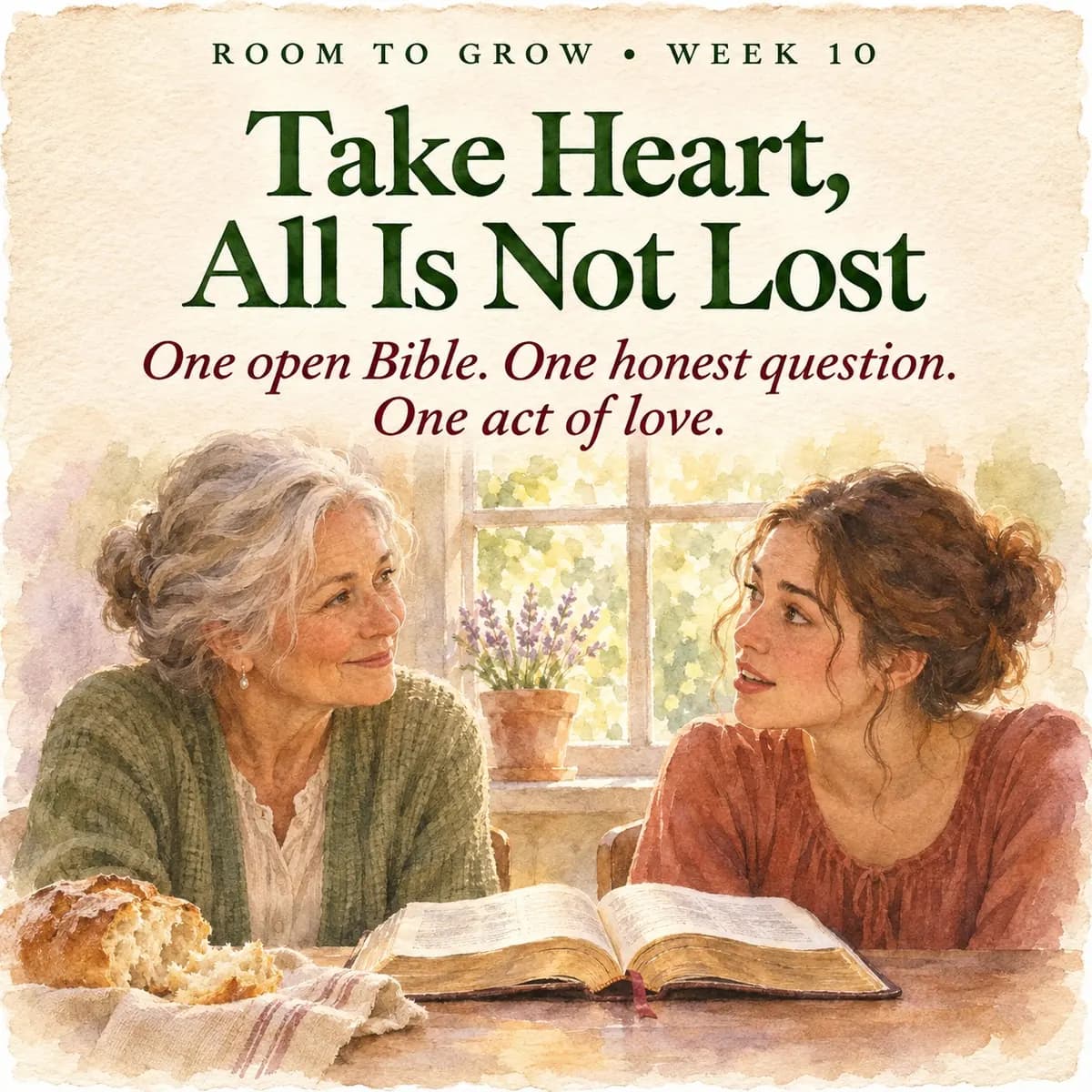
Room To Grow • A Tried & True Series
Week 10
Take Heart, All Is Not Lost
By Trish Tipton
If you've come all this way searching with me, thank you. Let's search together one more time. After seeing the difference between the first churches and so much of what we have inherited, and after looking ahead at trouble we may not be exempt from, is there still hope for the church? I believe there is. I have spent a lot of this series asking what has gone wrong, and I don't want to leave you discouraged. God has not stopped working.
Writing these pieces did something I did not expect. It surfaced old memories. Stories I had not thought about in years came back while I was sitting with the Word, and with the history of how we got here. Some of those memories were sweet. Some of them made me sad. All of them showed me how easily changes over about the last 150 years got us where we are. Not all at once. Gradually. A custom here, a note in the margin there, a habit that started to feel like it had always been the way. The tithe as an American church custom, the notes that taught so many of us what the end times would look like, the ways money and teaching and fear can quietly reshape what we think church is supposed to be. It happened without a lot of us even knowing it. We inherited it, and we passed it on, because it was what we were given.
The path we have been tracing is longer than that, about two thousand years of drift from the first churches. I still believe that. What writing this made personal for me is how much can change in a much shorter span, right under our feet, while we are busy living our lives. Nobody stood up one Sunday and announced that everything was about to become something different. A custom settled in. A note in a study Bible started doing the teaching. Money started flowing one way and not another. Fear taught us who to trust. Each piece felt ordinary at the time. Taken together, they brought us a long way from the people who broke bread from house to house with glad hearts, and from the ones who searched the Scriptures daily to see whether these things were so.
The really sad part, to me, is how much the younger generation is missing. Many of them have never heard these older stories. They have not been walked through the difference between what the first believers did and what we do now. They have inherited the results of those gradual changes without being told there was another way. Some of them think this is simply what church has always been, because no one ever showed them Acts beside a modern Sunday and asked them to look. Some of them have walked away, and I understand why, if all they were handed was a performance, a pressure to give, or a set of answers they were not allowed to question. Some of them are still sitting there, waiting for someone to be honest with them. I am not asking older people to lecture. I am asking us to tell the truth about what we found, and to listen when someone younger asks why things feel off.
My hope is that these stories can start a change in a few of them. Not a campaign. Not another brand. A few people who open the Book, ask a real question, and decide to live what they find. I don't expect a whole generation to turn around because somebody wrote a series of pieces. I do believe a story, told plainly, can give someone permission to look again. If even a handful of younger believers, or older ones who still have someone to tell, begin to search these things out for themselves, that would be enough to make the writing worth it.
We don't have to fix everything before we can do something faithful. That is where hope becomes something we practice, not only something we feel. We can open the Bible, ask an honest question, share a meal, and show somebody they have not been forgotten. A church can begin with the people it already has and the needs right outside its door.
Paul prayed for believers this way:
Romans 15:13 (NASB 2020)
13Now may the God of hope fill you with all joy and peace in believing, so that you will abound in hope by the power of the Holy Spirit.
Hope is not something I have to manufacture. God is the source of it. He can fill us with joy and peace as we trust Him, even while we still have questions. I want that kind of hope, the kind that comes from Him, not the kind that pretends nothing is wrong.
James makes the next step plain:
James 1:22 (NASB 2020)
22But prove yourselves doers of the word, and not just hearers who deceive themselves.
1 John 3:18 (NASB 2020)
18Little children, let’s not love with word or with tongue, but in deed and truth.
Read it, then live it. Love needs more than a good sentence. We talked earlier about encouraging one another in love and good deeds, and about not abandoning meeting together. That still stands. Not another performance. A gathering where we stir one another up to love people in deed and in truth.
I believe there's a way forward that doesn't need another grand campaign. Here are a few places I'd start.
I would start with churches being open about the money. Show the people giving it where it goes. Answer questions about salaries and property. When somebody designates a gift for a need, show them it reached that need. We sat with that when we asked how the first believers gave, and how anyone can follow a dollar today. Openness is not suspicion. It is love for the people who are trusting you with what they have.
I would read whole books of the Bible together. Take time with the setting. Ask what you don't understand. Welcome questions instead of treating them as disrespect. Small groups can make room for voices that never get heard from a stage. We already looked at the people in Berea who examined the Scriptures daily to see whether these things were so. That is still a good way to gather.
I would want us to know the people nearby. Find the widow who needs a ride, the person without enough food, and the neighbor who can't manage alone. Partner with people trained to help where a need is more than you can handle. We can be sensible without being cold. We talked about this when we asked who the church is for. If we will do the work of Christ, caring for people instead of only counting decisions, I still believe the Lord can add to the number, the way He did when the first believers had all things in common and were giving as anyone had need.
I would make room for leaders who also work other jobs. A pastor who tents, or teaches, or works with his hands during the week is not a lesser pastor. Paul did that. Support leaders honestly and generously, without making the building and the payroll the whole mission.
And I would give cheerfully. Find people and ministries you can help, ask honest questions, and give directly when that's the best way to meet a need. I said it when we talked about the tithe, and I still mean it. If this series has set you free from treating the tithe as a law you owe, I pray it has not set you free from giving. Find your own way to give, cheerfully, to the people God puts in front of you.
None of that is beyond us. We don't have to wait for every leader or institution to change, and we don't have to undo a hundred and fifty years in a week. We can start with an open Bible, an open hand, and a willingness to learn. One table. One honest question. One person who has been overlooked. And when a church is doing these things well, let's encourage it too. I can honor what is faithful where I find it, and still ask for more of what I see in the first churches.
When I go back to the beginning of this series, I land on the same verse that helped me see who we already are:
1 Peter 2:9 (NASB 2020)
9But you are A CHOSEN PEOPLE, A royal PRIESTHOOD, A HOLY NATION, A PEOPLE FOR GOD’S OWN POSSESSION, so that you may proclaim the excellencies of Him who has called you out of darkness into His marvelous light;
We already are who He called us to be. A chosen people. A royal priesthood. A holy nation. A people for God's own possession, so that we may proclaim His excellencies. That is not a title we earn by collecting enough good work, and it is not something we lose if our church building looks ordinary. It is who we are in Him. The question is whether we will live like it.
Being ready still matters. We talked about being ready in season and out of season, and about the prudent ones who kept oil in their lamps. I don't want us to hear "be ready" as "be afraid," or as "build your totals so you can leave." Last week we sat with Revelation's warning, and with people who stood with Christ even when it cost them. They were not remembered as panicked. They were remembered as victorious. We need to be ready for what is to come, with hope rather than fear. I want us to hear "be ready" as staying in season, doing His work, and trusting the God of hope while we wait.
What is one step you can take this week that looks more like the first churches, and that finds you in season?
I would rather you not take my word for any of this. Open your Bible and read it yourself. Read Romans 15 and ask the God of hope to fill you. Read Hebrews 10 and sit with what it means to encourage one another as the day draws near. Read James 1 and 1 John 3, and look at love that shows up in deed and in truth. Read 2 Timothy 3 and 4, and hear both the warning about people who will not endure sound teaching and the charge to be ready in season and out of season. Read 1 Peter 2 slowly, and remember who you already are. Read Matthew 25, and ask what readiness looks like, and who He said we were serving when we served "the least of these." Read Acts 2, and watch the Lord add to a people who were devoted, generous, and glad.
If something doesn't sit right, stay with it. If an old memory surfaced while you were reading, stay with that too. That's what happened to me as I wrote. The longer I sat with these questions, the more I saw how gradually we arrived here, and the more I wanted someone younger than I am to hear another way before the gradual changes feel like the only way there ever was.
Thank you for searching the Word with me through all of these questions. I am grateful you stayed with the hard parts, and with the hope too. Take heart. All is not lost.
Scripture quotations taken from the (NASB®) New American Standard Bible®, Copyright © 1960, 1971, 1977, 1995, 2020 by The Lockman Foundation. Used by permission. All rights reserved. lockman.org