
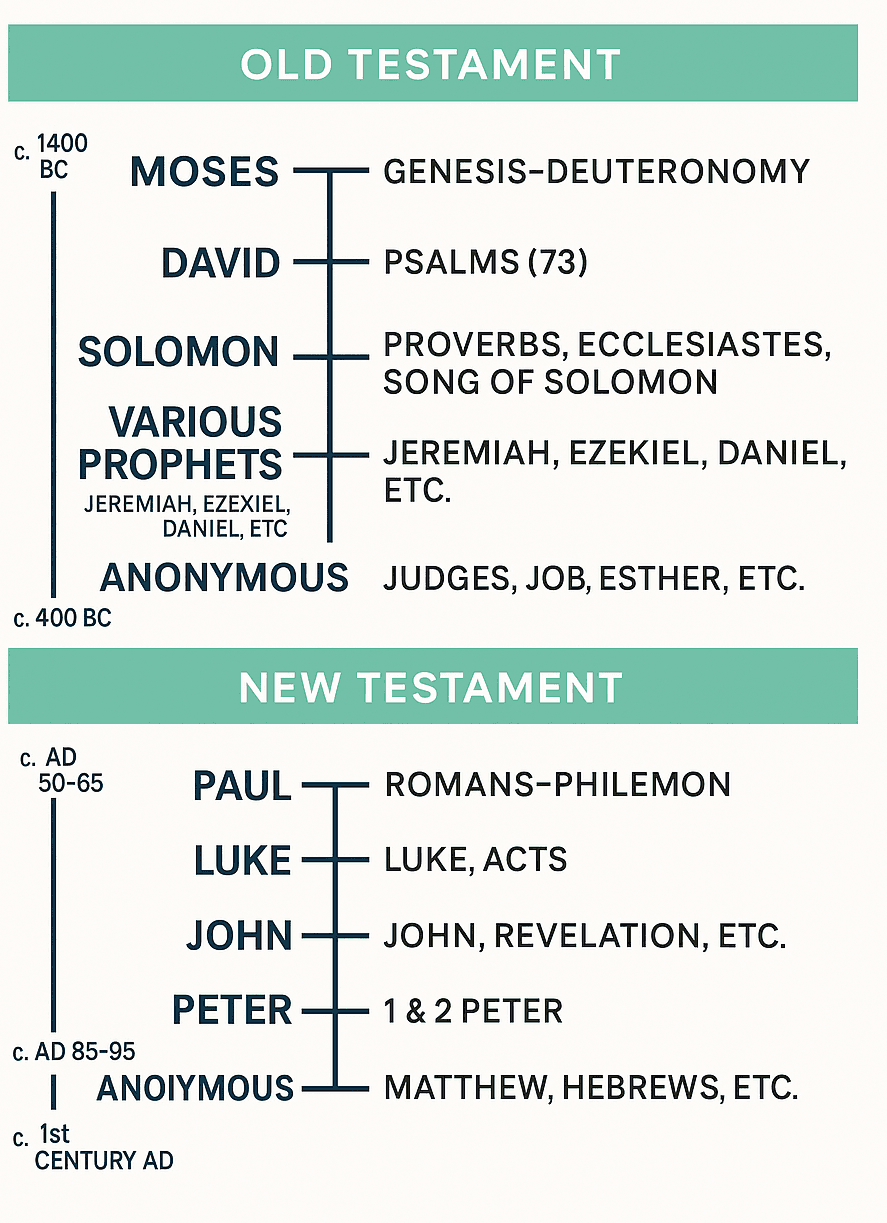
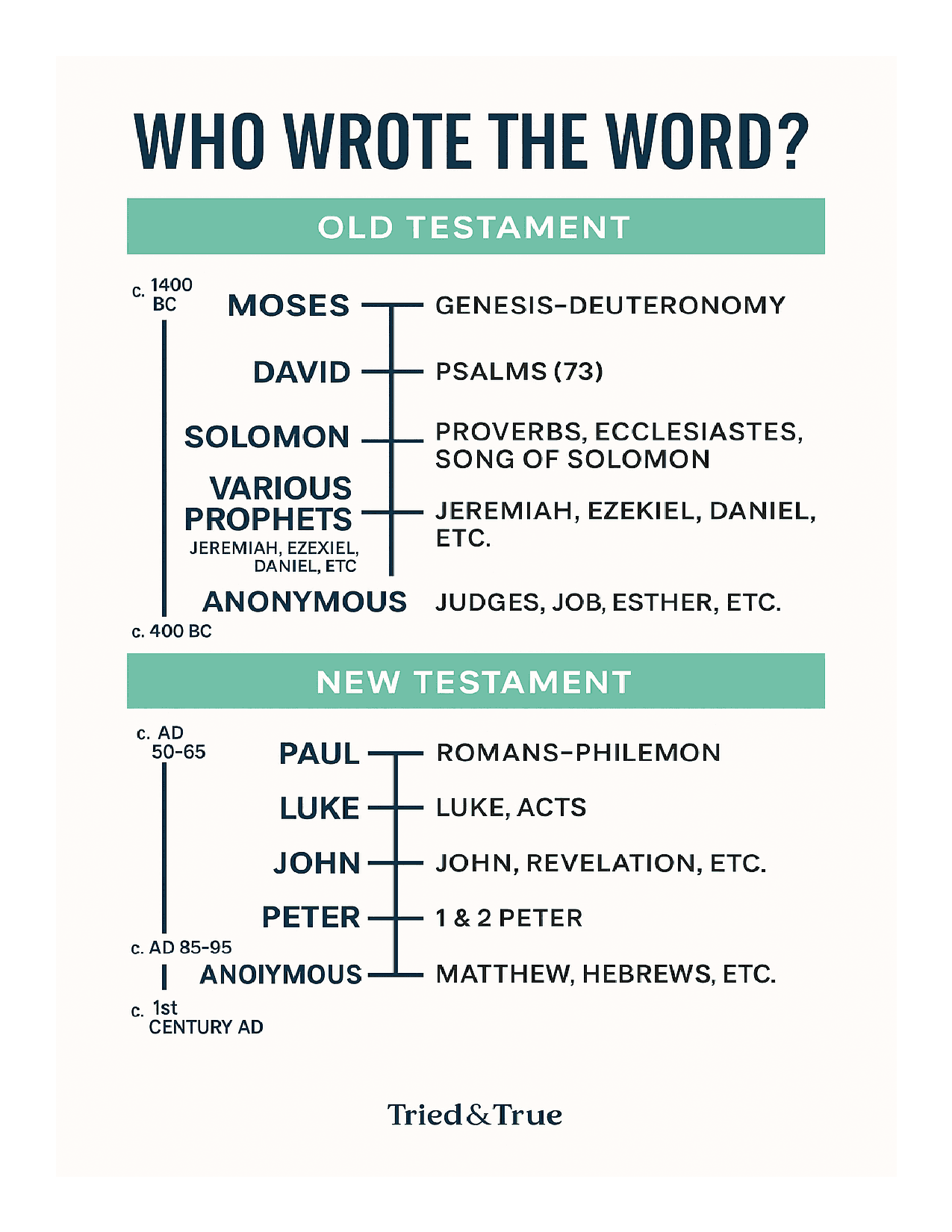
Who Wrote the Word?
A complete guide to the authors of the Old and New Testament — their eras, roles, and stories.
The Bible is a sacred compilation of history, law, poetry, and prophecy written over a span of approximately 1,500 years by more than 40 authors. Understanding who wrote each book helps us connect more deeply with its context, purpose, and message. From Moses in the wilderness to John on the island of Patmos, every writer was moved by the same Spirit and carried a unique piece of God's unfolding story.
Old Testament Overview
The Old Testament books are traditionally grouped into five categories: the Pentateuch (Law), Historical Books, Wisdom Literature, Major Prophets, and Minor Prophets. Written over roughly 1,000 years, they trace God's covenant from creation through Israel's exile and return.
The Pentateuch (The Torah — Law)
- Genesis — Moses. Covers creation, the patriarchs, and God's covenant beginnings.
- Exodus — Moses. Documents Israel's deliverance from Egypt and the giving of the Law.
- Leviticus — Moses. Detailed laws for worship, sacrifice, and priestly conduct.
- Numbers — Moses. Chronicles the wilderness journey and censuses of Israel.
- Deuteronomy — Moses. A retelling of the Law before entering the Promised Land.
Historical Books
- Joshua — Traditionally attributed to Joshua. Covers conquest and division of Canaan.
- Judges — Possibly Samuel. Describes the cycle of rebellion and deliverance.
- Ruth — Unknown; possibly Samuel. A love story that illustrates redemption.
- 1 & 2 Samuel — Possibly Samuel, Nathan, and Gad.
- 1 & 2 Kings — Traditionally attributed to Jeremiah.
- 1 & 2 Chronicles — Attributed to Ezra. Focuses on Judah and temple worship.
- Ezra — Ezra. Chronicles the return from exile and temple restoration.
- Nehemiah — Nehemiah. Memoir-style account of rebuilding Jerusalem's walls.
- Esther — Unknown author. Tells the story of Jewish deliverance in Persia.
Wisdom Literature (Poetry & Instruction)
- Job — Unknown; possibly Moses or Solomon. Explores suffering and divine justice.
- Psalms — Various authors (David, Asaph, Sons of Korah, Solomon, Moses, Ethan, anonymous).
- Proverbs — Primarily Solomon; later collections added by Hezekiah's scribes.
- Ecclesiastes — Solomon, writing as 'The Preacher'. A reflection on life's meaning.
- Song of Solomon — Solomon. A poetic celebration of love and covenant.
Major Prophets
- Isaiah — Prophet Isaiah. Active during the reigns of Uzziah, Hezekiah, and others.
- Jeremiah — Prophet Jeremiah. Includes biographical and prophetic content.
- Lamentations — Traditionally attributed to Jeremiah. Poetic mourning over Jerusalem.
- Ezekiel — Prophet Ezekiel. Visionary messages during Babylonian exile.
- Daniel — Daniel. Apocalyptic and historical accounts from Babylon and Persia.
Minor Prophets (The Book of the Twelve)
- Hosea — Prophet to Israel — themes of faithful love.
- Joel — Prophet to Judah — themes of repentance and the Day of the Lord.
- Amos — Shepherd prophet — strong justice themes.
- Obadiah — Shortest OT book — message to Edom.
- Jonah — Reluctant prophet to Nineveh.
- Micah — Judgment and hope — messianic prophecy.
- Nahum — Judgment on Nineveh.
- Habakkuk — Dialogue with God on justice.
- Zephaniah — Warning of judgment and restoration.
- Haggai — Post-exile encouragement to rebuild the temple.
- Zechariah — Apocalyptic visions and messianic prophecy.
- Malachi — Final OT prophet before 400 years of silence.
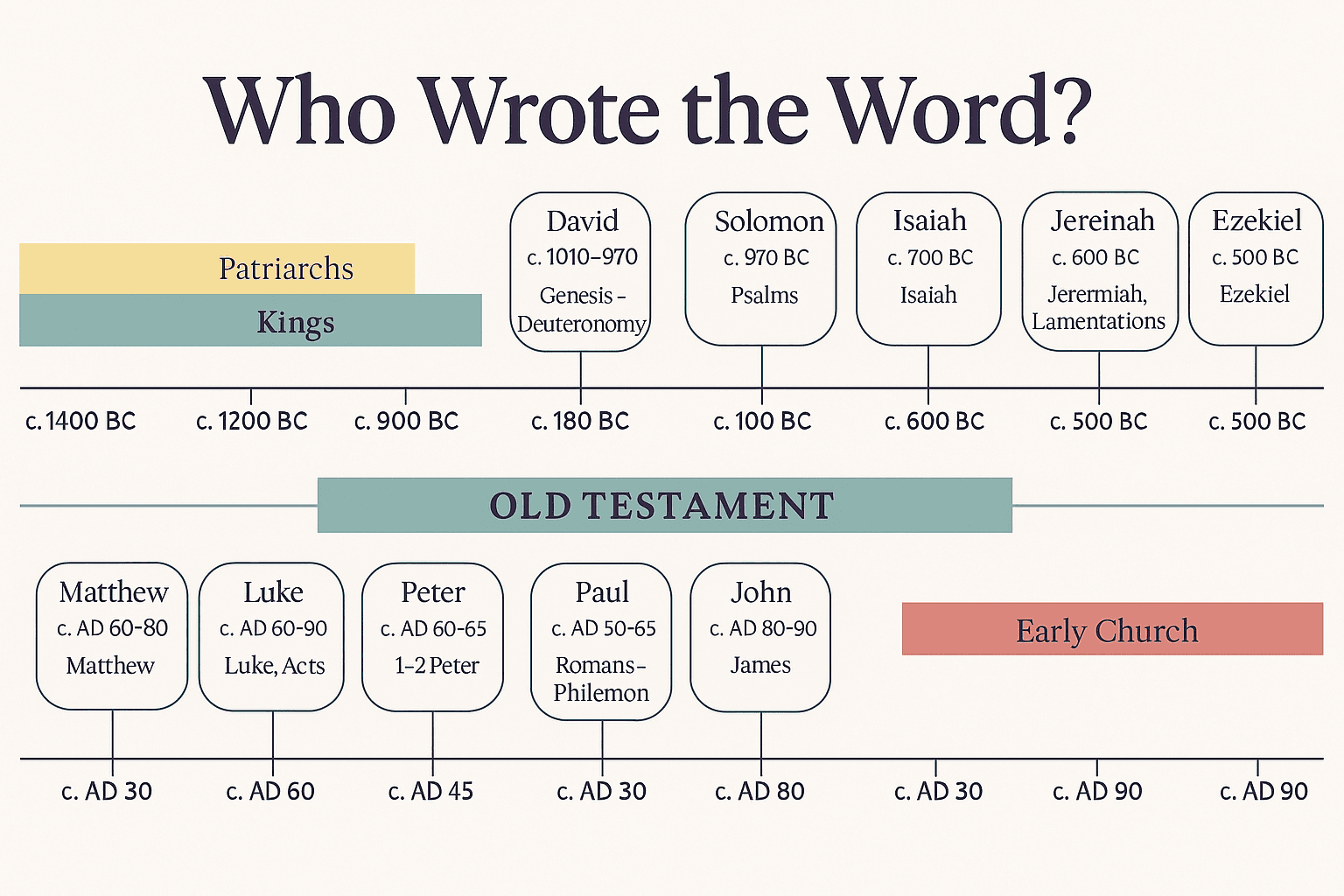
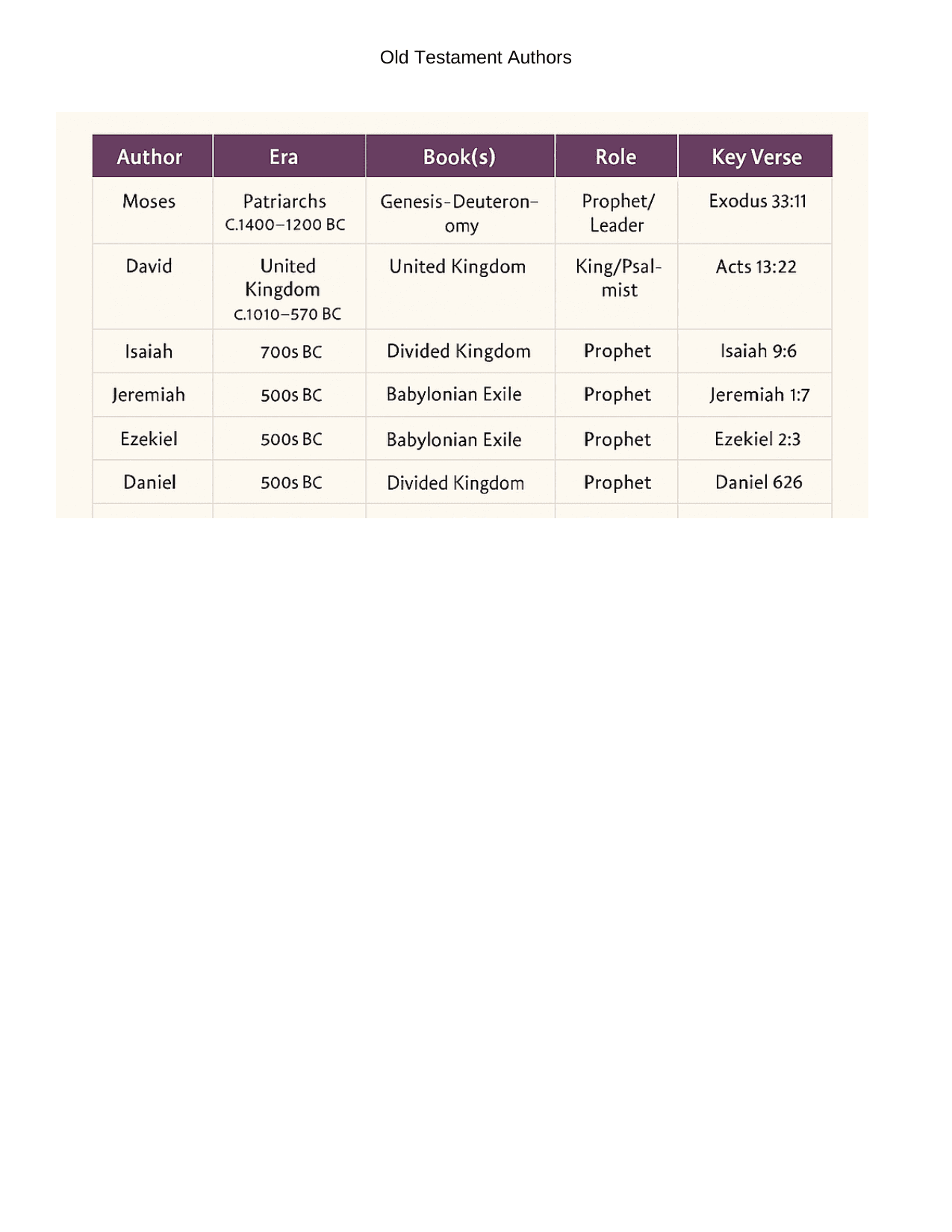
Old Testament Authors at a Glance
| Author | Era | Books | Role | Key Scripture |
|---|---|---|---|---|
| Moses | 1445–1405 BC | Genesis, Exodus, Leviticus, Numbers, Deuteronomy, Psalm 90 | Lawgiver, Prophet | Deuteronomy 34:10 |
| Joshua | 1405–1380 BC | Joshua | Leader after Moses | Joshua 1:9 |
| Samuel | 1100–1010 BC | 1 Samuel, parts of Judges & Ruth | Prophet, Judge | 1 Samuel 3:19–20 |
| David | 1010–970 BC | Psalms (73–75 attributed) | King, Psalmist | Psalm 23:1 |
| Solomon | 970–931 BC | Proverbs, Ecclesiastes, Song of Songs | King, Teacher | Proverbs 1:7 |
| Isaiah | 740–681 BC | Isaiah | Prophet | Isaiah 9:6 |
| Jeremiah | 627–580 BC | Jeremiah, Lamentations | Prophet | Jeremiah 1:5 |
| Ezekiel | 593–571 BC | Ezekiel | Prophet | Ezekiel 36:26 |
| Daniel | 605–530 BC | Daniel | Prophet | Daniel 6:10 |
| Ezra | 480–440 BC | Ezra | Priest, Scribe | Ezra 7:10 |
| Nehemiah | 445–420 BC | Nehemiah | Governor, Leader | Nehemiah 8:10 |
| Malachi | 430 BC | Malachi | Prophet | Malachi 3:1 |
New Testament Overview
The New Testament was written in the first century AD by eyewitnesses and close companions of Jesus. Written in Greek and spread across the Roman world, these 27 books form the foundation of Christian faith — from the Gospels that record Jesus's life to the letters that shaped the early church.
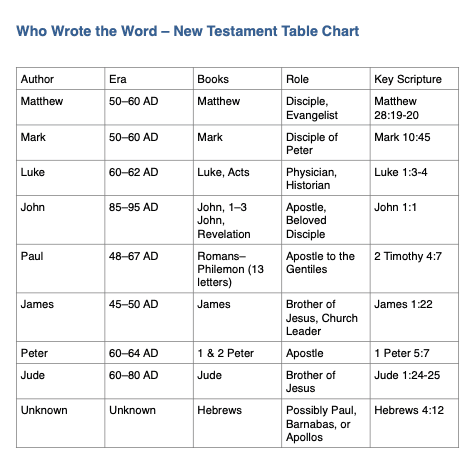
New Testament Authors at a Glance
| Author | Era | Books | Role | Key Scripture |
|---|---|---|---|---|
| Matthew | 50–60 AD | Matthew | Disciple, Evangelist | Matthew 28:19–20 |
| Mark | 50–60 AD | Mark | Disciple of Peter | Mark 10:45 |
| Luke | 60–62 AD | Luke, Acts | Physician, Historian | Luke 1:3–4 |
| John | 85–95 AD | John, 1–3 John, Revelation | Apostle, Beloved Disciple | John 1:1 |
| Paul | 48–67 AD | Romans–Philemon (13 letters) | Apostle to the Gentiles | 2 Timothy 4:7 |
| James | 45–50 AD | James | Brother of Jesus, Church Leader | James 1:22 |
| Peter | 60–64 AD | 1 & 2 Peter | Apostle | 1 Peter 5:7 |
| Jude | 60–80 AD | Jude | Brother of Jesus | Jude 1:24–25 |
| Unknown | Unknown | Hebrews | Possibly Paul, Barnabas, or Apollos | Hebrews 4:12 |
Meet the Writers
Old Testament Writers — Mini Biographies
Moses
The reluctant leader who became a mighty deliverer. Raised in Pharaoh's palace but called by God from a burning bush, Moses led Israel out of slavery and into covenant with the living God. He wrote the first five books of the Bible (Genesis through Deuteronomy), shaping Israel's identity as a chosen nation. He was a lawgiver, a prophet, an intercessor, and a man who met with God ‘face to face.’ Yet even Moses struggled with anger, doubt, and disappointment — reminding us that even the faithful are still human. He died before entering the Promised Land, but stood with Jesus on the Mount of Transfiguration.
David
The shepherd boy turned king, David was a man after God's own heart. He didn't just fight giants — he fought despair, betrayal, and his own sin. His psalms reflect the raw honesty of a heart that loved God deeply yet stumbled greatly. He wrote more than 70 psalms and helped establish worship in Israel. Despite his failures, he is remembered for his repentance and his passion. His life teaches us that worship isn't about perfection — it's about pursuit.
Asaph
A Levite musician appointed by David to lead worship in the temple. Asaph wasn't just a singer — he was a prophet-poet whose psalms wrestle with injustice and the prosperity of the wicked. His writing (Psalms 73–83) brings a priestly perspective to pain, yet ends in hope. He teaches us that worship includes questions, laments, and reverence — and that God welcomes it all.
Ezra
A priest and scribe who helped rebuild Israel's spiritual foundation after the Babylonian exile. Ezra was devoted to the Law of God and led a return to worship and repentance. He likely compiled historical books like 1 & 2 Chronicles and may have had a hand in finalizing the structure of the Old Testament. Ezra reminds us of the power of godly leadership rooted in truth, humility, and courage.
Solomon
Son of David, king of Israel, and the wisest man who ever lived — until he wasn't. Solomon began with a heart that asked God for wisdom and built the glorious temple, but his later years were marked by compromise and idolatry. He wrote Proverbs, Ecclesiastes, and the Song of Songs. His writings reflect brilliance, beauty, and warning. Solomon's life is a sobering reminder: wisdom must be followed, not just spoken.
Sons of Korah
Descendants of the Levite Korah, whose ancestor rebelled but whose line was preserved by grace. These temple musicians contributed worship psalms marked by longing, trust, and deep connection with God's presence. They wrote Psalms like 'As the deer pants for the water.' Their legacy reminds us that redemption runs deep, and God can bring beauty from a broken lineage.
Ethan the Ezrahite
A wise man from Solomon's era, known for his deep insight and poetic expression. Though he only penned Psalm 89, his words stand as a powerful reflection on God's promises and Israel's struggles. His writing bridges hope and heartbreak, and teaches us to wrestle with God's faithfulness in seasons of silence.
Jeremiah
Known as the weeping prophet, Jeremiah was called as a young man and remained faithful through ridicule, imprisonment, and national collapse. He authored both the Book of Jeremiah and Lamentations. His life models courageous obedience and emotional honesty with God in the face of suffering.
Daniel
A captive in Babylon who became a powerful witness for God in a foreign land. Daniel was wise, prayerful, and bold — even in the face of lions. His book includes both historical narrative and apocalyptic prophecy. Daniel's integrity reminds us that we can thrive spiritually even when we feel exiled.
Isaiah
One of the greatest prophets, Isaiah ministered during the reigns of several kings in Judah. His book is rich in messianic prophecy, poetic beauty, and divine judgment. He saw the Lord 'high and lifted up' and responded, 'Here am I, send me.' His voice calls us to repentance, trust, and awe.
Nehemiah
A cupbearer turned builder, Nehemiah's passion for God's glory moved him to rebuild Jerusalem's walls. His memoir-like book captures both spiritual leadership and practical wisdom. Nehemiah was bold in prayer, decisive in conflict, and unwavering in vision. He shows us how faith and action can restore broken places.
Job
The central figure in one of the Bible's oldest stories, Job is a man who lost everything and still clung to God. The book bearing his name explores suffering, divine justice, and perseverance. Though he never receives all the answers, Job's journey ends with deeper revelation. His life is proof that faith refined in the fire still shines.
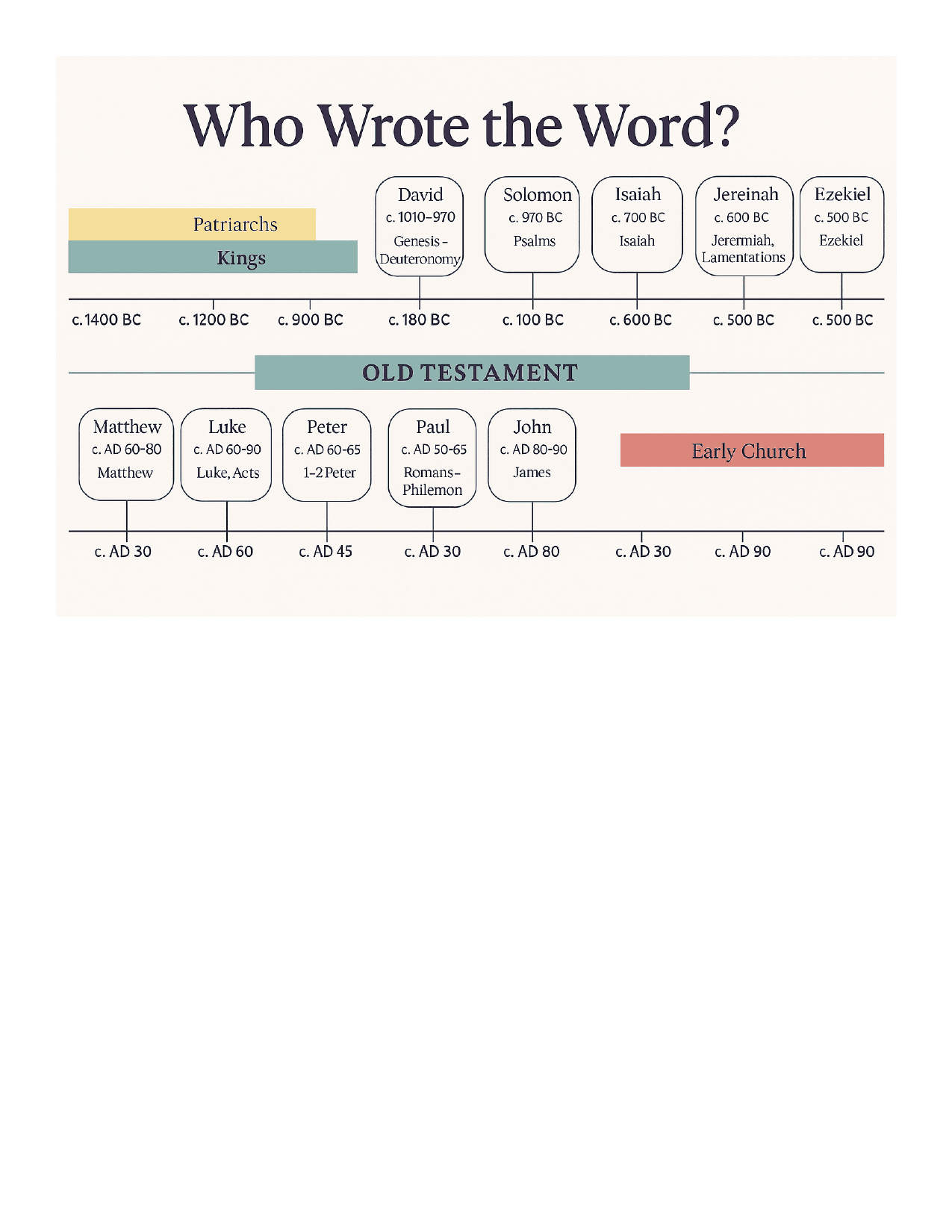
Want to save or print this guide? Download the full PDF version.
Download PDF