
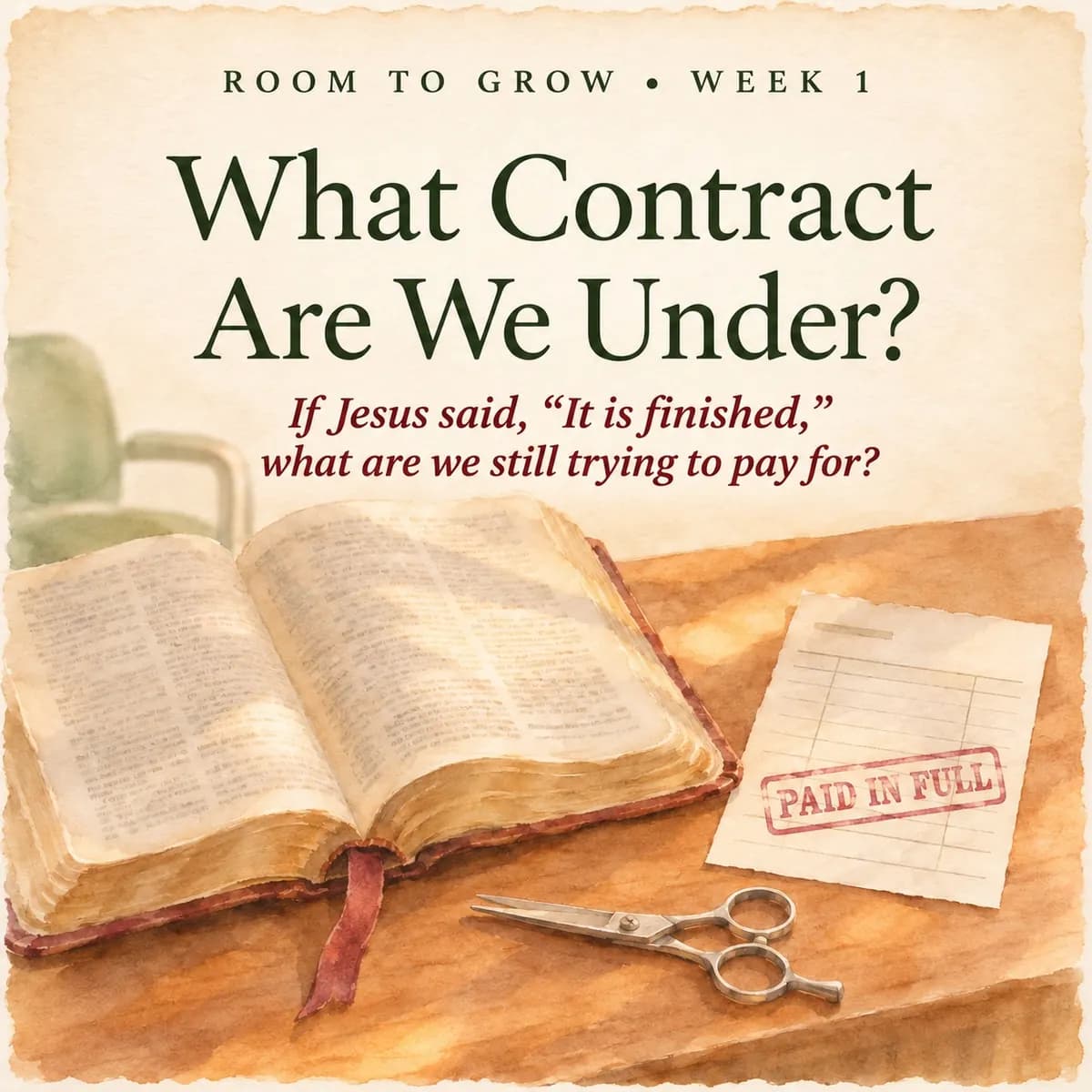
Room To Grow • A Tried & True Series
Week 1
What Contract Are We Under?
By Trish Tipton
If we were sitting down together, this is what I'd want to talk through with you, as someone who has been carrying questions for a long time, and who finally started taking them to the Word instead of just accepting what I was told.
I've been doing hair since 1976, and if there's one thing my clients have taught me, it's that people have questions they never say out loud in church. I'm one of them. I'm not a preacher, but I did have training in ministry almost 20 years ago. I spent a year in ministry training in 2007 and 2008, and then two weeks in Ibagué, Colombia, putting into practice what I had learned. I decided I could do more behind my chair and in my community than I could in another country. These days I encourage pastors online through Messenger and email, and I share the papers I've written on my website. Honestly, I've learned more from them than I did in training.
This is my journey, not the last word. Please don't take my words as gospel, or anyone else's. I'm going to tell you what I've found when I went looking, and I hope you'll go look too.
Something happened when I was 17 that I won't go into here, but it prompted me to go out and buy a cross to remember that time. I didn't really understand why at the time. It wasn't until years later that I realized God was with me even then.
I wasn't raised in church. I became a Christian when I was 25, and I got involved in a Baptist church. After I married in 1981, I spent 15 years in the Baptist church as a youth director for high school kids (not a minister), a Bible study leader, and president of the Woman's Missionary Union (WMU). And I'll tell you the truth: I never once questioned that what the pastor told us was the truth. Not that I thought he was lying. I just figured if he was a pastor, he'd have to know the Word of God backwards and forwards.
So when I heard the word "covenant" from the pulpit, I nodded along like I knew what it meant. I knew it was something big and holy between God and people, but I couldn't have explained it to a client sitting in my chair if she'd asked me. I took it on trust. It wasn't until later that I started studying things out for myself.
And that left me with a simple problem. If I don't know what a covenant is, how would I know which one I'm living under?
A covenant, as best I can tell from reading it, is an agreement between God and His people, with promises and terms, and it's sealed. When I put it in plain words for myself, I think of a contract. That's a word I understand. The first big one most of us mean when we say "the old covenant" was made at Mount Sinai, after God brought Israel out of Egypt. God told Moses what to say to the people:
Exodus 19:5-8 (NASB 2020)
5Now then, if you will indeed obey My voice and keep My covenant, then you shall be My own possession among all the peoples, for all the earth is Mine; 6and you shall be to Me a kingdom of priests and a holy nation.’ These are the words that you shall speak to the sons of Israel.” 7So Moses came and called the elders of the people, and set before them all these words which the LORD had commanded him. 8Then all the people answered together and said, “All that the LORD has spoken we will do!” And Moses brought back the words of the people to the LORD.
Notice what's there. It's an "if." If you obey and keep My covenant, then you will be My own possession. And the people said yes. Every one of them. God also told them what they would be if they kept it: "a kingdom of priests and a holy nation." That line matters more than I used to realize, and I want to come back to it.
A few chapters later, Moses reads the whole agreement out loud, and they say yes again. Then it gets sealed, and not with a signature.
Exodus 24:7-8 (NASB 2020)
7Then he took the Book of the Covenant and read it as the people listened; and they said, “All that the LORD has spoken we will do, and we will be obedient!” 8So Moses took the blood and sprinkled it on the people, and said, “Behold the blood of the covenant, which the LORD has made with you in accordance with all these words.”
The Book of the Covenant. The blood of the covenant. That's a contract if I ever saw one, with both sides agreeing to the terms. The trouble is, the rest of the Old Testament shows us how well the people kept their side. They didn't. Not for long, anyway.
And then I found this, and I'll be honest, I sat with it a while. Hundreds of years after Sinai, God speaks through the prophet Jeremiah, and He promises something different:
Jeremiah 31:31-34 (NASB 2020)
31“Behold, days are coming,” declares the LORD, “when I will make a new covenant with the house of Israel and the house of Judah, 32not like the covenant which I made with their fathers on the day I took them by the hand to bring them out of the land of Egypt, My covenant which they broke, although I was a husband to them,” declares the LORD. 33“For this is the covenant which I will make with the house of Israel after those days,” declares the LORD: “I will put My law within them and write it on their heart; and I will be their God, and they shall be My people. 34They will not teach again, each one his neighbor and each one his brother, saying, ‘Know the LORD,’ for they will all know Me, from the least of them to the greatest of them,” declares the LORD, “for I will forgive their wrongdoing, and their sin I will no longer remember.”
"Not like the covenant which I made with their fathers." God Himself said a new one was coming, and that it would be a different kind of agreement. Not written on stone, but on the heart. Not "if you obey, then." Instead, "I will forgive their wrongdoing, and their sin I will no longer remember."
That one stopped me in my tracks. This promise was there in the Old Testament the whole time.
When I turned to the New Testament, I started seeing how that promise landed. At the last supper, Jesus took the cup and said:
Luke 22:20 (NASB 2020)
20And in the same way He took the cup after they had eaten, saying, “This cup, which is poured out for you, is the new covenant in My blood.
The new covenant, in His blood. The same kind of sealing the old one had, only this time it was His.
He didn't come to throw the old contract in the trash. He came to fulfill it. Here is what He said in the Sermon on the Mount:
Matthew 5:17-18 (NASB 2020)
17“Do not presume that I came to abolish the Law or the Prophets; I did not come to abolish, but to fulfill. 18For truly I say to you, until heaven and earth pass away, not the smallest letter or stroke of a letter shall pass from the Law, until all is accomplished!
He said not one letter would pass "until all is accomplished." So I kept asking, did He accomplish it?
Here are His words from the cross:
John 19:30 (NASB 2020)
30Therefore when Jesus had received the sour wine, He said, “It is finished!” And He bowed His head and gave up His spirit.
"It is finished." Not "it's almost finished," and not "it's finished except for a few parts you'll still need to keep up." Finished. Matthew says that when He gave up His spirit, the veil of the temple was torn in two from top to bottom:
Matthew 27:50-51 (NASB 2020)
50And Jesus cried out again with a loud voice, and gave up His spirit. 51And behold, the veil of the temple was torn in two from top to bottom; and the earth shook and the rocks were split.
The way into God's presence, which used to belong to a priesthood behind a curtain, was opened. Later, Hebrews talks about that as a new and living way through the veil, and about Jesus as a great priest over the house of God:
Hebrews 10:19-22 (NASB 2020)
19Therefore, brothers and sisters, since we have confidence to enter the holy place by the blood of Jesus, 20by a new and living way which He inaugurated for us through the veil, that is, through His flesh, 21and since we have a great priest over the house of God, 22let’s approach God with a sincere heart in full assurance of faith, having our hearts sprinkled clean from an evil conscience and our bodies washed with pure water.
And Paul describes what happened to the bill itself:
Colossians 2:13-14 (NASB 2020)
13And when you were dead in your wrongdoings and the uncircumcision of your flesh, He made you alive together with Him, having forgiven us all our wrongdoings, 14having canceled the certificate of debt consisting of decrees against us, which was hostile to us; and He has taken it out of the way, having nailed it to the cross.
"The certificate of debt." Canceled. Taken out of the way. Nailed to the cross. When I read that, I thought about a receipt marked paid. You don't keep a canceled bill on the counter and keep making payments on it.
Let me tell you how that plays out in my chair, because this is where it became real to me.
I've been doing hair since 1976. That's a lot of clients, a lot of appointments, and a lot of simple agreements. You sit in my chair, I do what we agreed on, you pay me, and we're square. Nobody has to explain that to anybody. It's just fair.
I can't recut your hair the next day and expect you to have any hair left. I need to move on to the next day's clients. That appointment is done, and we both know it.
Say a client calls and books a cut and color. We agree on what she wants and what it costs. She sits down, I do the work, she loves it, and she pays me in full. Done. That contract is finished.
Now imagine I send her a bill the next week for that same cut and color. Then another one the week after. She'd look at me like I'd lost my mind, and she'd be right. She'd say, "Trish, I paid you. We're done."
Or turn it around. Imagine she kept coming back every week, sitting in my chair and trying to pay me again for that one appointment, because she was afraid it didn't really count. I'd hand her money back and tell her, "Honey, you're paid up."
That's how I see the old covenant. It was a real contract with real terms. And it's been fulfilled. Nobody gets to keep billing on it, and nobody needs to keep paying on it out of fear that it didn't count.
Hebrews says it in even plainer language. Jesus is the mediator of a better covenant:
Hebrews 8:6-7 (NASB 2020)
6But now He has obtained a more excellent ministry, to the extent that He is also the mediator of a better covenant, which has been enacted on better promises. 7For if that first covenant had been free of fault, no circumstances would have been sought for a second.
Hebrews 8:13 (NASB 2020)
13When He said, “A new covenant,” He has made the first obsolete. But whatever is becoming obsolete and growing old is about to disappear.
"Obsolete." That's a strong word. I'm not using it to dismiss the Old Testament. I love those books, and they are still God's Word. They show us His heart and they point us to Jesus. What I hear Hebrews saying is that we don't live under that first contract anymore. A new one is in place, and it was sealed in His blood.
There's something else that changes with it, and I missed this for years. Under the old covenant, Israel had a priesthood: one tribe, the Levites, who served at the tabernacle and later at the temple. The people didn't all walk into the holy place. Hebrews says that when the priesthood changes, the law changes with it:
Hebrews 7:11-12 (NASB 2020)
11So if perfection was through the Levitical priesthood (for on the basis of it the people received the Law), what further need was there for another priest to arise according to the order of Melchizedek, and not be designated according to the order of Aaron? 12For when the priesthood is changed, of necessity there takes place a change of law also.
If the priesthood has changed, we shouldn't expect everything that belonged to that old priesthood to transfer over as if nothing happened. And who is the priesthood now? Go back to what God said at Sinai: "you shall be to Me a kingdom of priests and a holy nation." Peter picks that up and says it to believers in Jesus:
1 Peter 2:9 (NASB 2020)
9But you are A CHOSEN PEOPLE, A royal PRIESTHOOD, A HOLY NATION, A PEOPLE FOR GOD’S OWN POSSESSION, so that you may proclaim the excellencies of Him who has called you out of darkness into His marvelous light;
A royal priesthood. A holy nation. A people for God's own possession. That's not a few professionals up front and the rest of us sitting in the seats. In Christ, that is who we are. The work of representing Him and coming to God is not locked behind a curtain anymore.
And it isn't locked inside one bloodline either. This is the part I want to be especially careful and clear about, because it is good news, not a swipe at anyone.
Paul says that in Christ we are Abraham's descendants, and that the old dividing lines do not decide who belongs:
Galatians 3:28-29 (NASB 2020)
28There is neither Jew nor Greek, there is neither slave nor free, there is neither male nor female; for you are all one in Christ Jesus. 29And if you belong to Christ, then you are Abraham’s descendants, heirs according to promise.
"Neither Jew nor Greek." If you belong to Christ, you are Abraham's descendant, an heir according to promise. Jewish believers are not pushed out. Gentile believers are not second class. We are one in Him.
Paul says the same thing another way to the church in Ephesus. He is talking about Jewish and Gentile believers, and about what Jesus did to the wall between them:
Ephesians 2:14-16 (NASB 2020)
14For He Himself is our peace, who made both groups into one and broke down the barrier of the dividing wall, 15by abolishing in His flesh the hostility, which is the Law composed of commandments expressed in ordinances, so that in Himself He might make the two one new person, in this way establishing peace; 16and that He might reconcile them both in one body to God through the cross, by it having put to death the hostility.
He Himself is our peace. He made both groups into one. He broke down the barrier of the dividing wall. He made the two "one new person," and reconciled them both in one body to God through the cross. That is the fulfillment of the covenant, not a leftover piece of the old one.
The first churches had to work this out in real time. In Acts 15, some men started teaching Gentile believers that they couldn't be saved unless they were circumcised according to the custom of Moses:
Acts 15:1 (NASB 2020)
1Some men came down from Judea and began teaching the brothers, “Unless you are circumcised according to the custom of Moses, you cannot be saved.”
Acts 15:5 (NASB 2020)
5But some of the sect of the Pharisees who had believed stood up, saying, “It is necessary to circumcise them and to direct them to keep the Law of Moses.”
In other words, they were saying Gentiles had to become Jewish, and keep the Law of Moses, in order to belong. The apostles and elders met in Jerusalem to look into it. After a lot of debate, Peter stood up and said God had already given the Holy Spirit to the Gentiles, just as He had to the Jewish believers:
Acts 15:8-11 (NASB 2020)
8And God, who knows the heart, testified to them giving them the Holy Spirit, just as He also did to us; 9and He made no distinction between us and them, cleansing their hearts by faith. 10Since this is the case, why are you putting God to the test by placing upon the neck of the disciples a yoke which neither our forefathers nor we have been able to bear? 11But we believe that we are saved through the grace of the Lord Jesus, in the same way as they also are.”
No distinction. Hearts cleansed by faith. Saved through the grace of the Lord Jesus, in the same way. James agreed that they should not cause trouble for the Gentiles who were turning to God:
Acts 15:19 (NASB 2020)
19Therefore, it is my judgment that we do not cause trouble for those from the Gentiles who are turning to God,
Gentiles did not have to become Jewish to be saved. They did not have to take on the old contract in order to enter the new one. The first church settled that at the beginning, and I think we still need to hear it. In Christ we are the people of God that Israel pictured: a royal priesthood, a holy nation, Abraham's children by faith, neither Jew nor Greek.
None of that is against Jewish people. Any Jewish person who comes to Christ is as much a child of Abraham as ever. And so is a Gentile hairstylist from Tulsa. We're one family, by faith.
When I put all of that together, a lot of other questions start to look different. If the old contract is paid up, why would we keep trying to live under pieces of it? If we are already a royal priesthood, why do so many of us live as if ministry belongs to a few and the rest of us are just an audience? If the first churches knew Gentiles didn't have to become Jewish to belong, what else have we picked back up along the way that they had already set down?
I'm not asking those questions to point a finger at your church, or at you. I had to ask them of myself first. I nodded along for years. The more I read, the more I can see how different so much of church life today can look from the first churches and what they were for. Some of that didn't happen overnight. It looks to me like a long, slow drift, over a very long stretch of years, about two thousand of them. I want to walk through that with you in the weeks ahead: how they gave, who they made room for, how they handled what they had, how they read the Word, and how we can be ready for what is coming without living scared.
We'll get to those things. Today I just wanted to start where I had to start. What is a covenant? Which one are we living under? And who does Scripture say we are, now that Jesus has said, "It is finished"?
I would rather you not take my word for any of this. Open your Bible and read it yourself. Read Exodus 19 and 24, where the old covenant is made and sealed. Read Jeremiah 31, where God promises a new one. Read Matthew 5 and John 19 and Colossians 2, and sit with "It is finished" and with that canceled certificate of debt. Read Luke 22, Hebrews 7 through 10, and 1 Peter 2. Read Galatians 3, Ephesians 2, and Acts 15, and see for yourself who is included when the covenant is fulfilled in Christ.
If something doesn't sit right, stay with it. If something opens up, stay with that too. That's how this started for me: one word I couldn't have explained to a client in my chair, and a growing sense that I needed to know which contract I was under.
Scripture quotations taken from the (NASB®) New American Standard Bible®, Copyright © 1960, 1971, 1977, 1995, 2020 by The Lockman Foundation. Used by permission. All rights reserved. lockman.org