
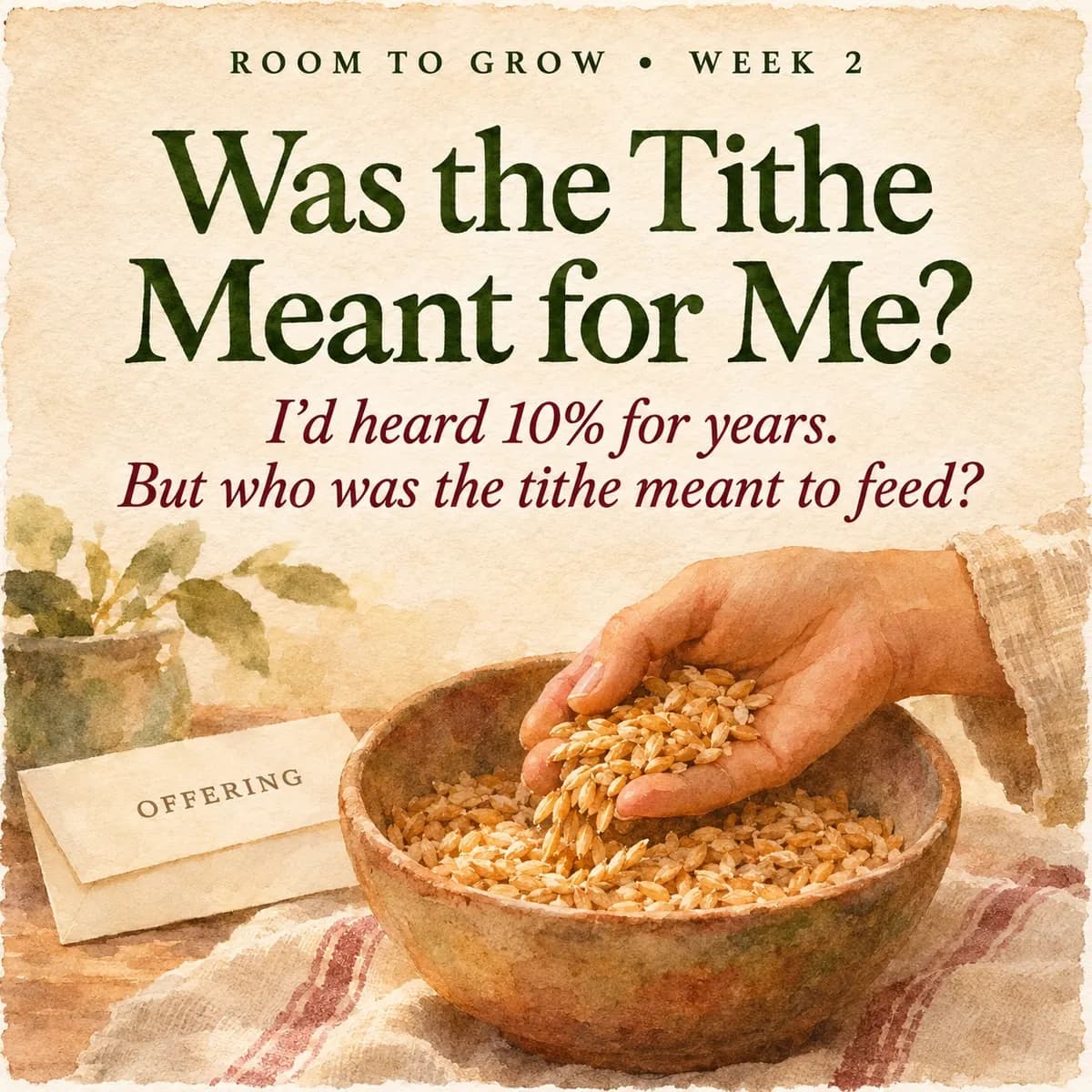
Room To Grow • A Tried & True Series
Week 2
Was the Tithe Meant for Me?
By Trish Tipton
If you've come back again, I'm guessing it's because you're looking for answers too. I can't promise I have them all, but I sure have a lot of questions. So let's dive in. I'm not here to pick a fight with anyone's church or to talk anyone out of being generous. I just want to look at what the Bible actually says about the tithe, all of it, not only the piece we usually hear before the offering.
Last time we talked about covenants, and about a contract that's been paid up. Jesus said, "It is finished." Hebrews also said that when the priesthood is changed, the law changes with it:
Hebrews 7:12 (NASB 2020)
12For when the priesthood is changed, of necessity there takes place a change of law also.
I keep coming back to that, because the tithe in the Old Testament was tied to a priesthood that has changed. If a client paid me in full for a haircut, I wouldn't send her another bill the next week, and I wouldn't let her keep trying to pay me again out of fear that it didn't count. I'd tell her, "Honey, you're paid up." I don't want to repeat that whole story. I just don't want us to forget it while we look at this, because so much of what we call tithing is treated like an open bill on a contract Jesus already fulfilled.
Ten percent. If you've spent any time in church, you've heard that number. It's preached, it's printed on offering envelopes, and it's treated like it came straight down from heaven. For a lot of people it's the first thing they learn about money and God. I've carried this question for years: who decided on 10 percent? Where does it actually come from in the Bible? And does it apply to me?
I'm the kind of person who likes to look at the traditions we've grown used to in church and ask which ones actually line up with Scripture. The tithe is one of the longest-standing of those questions for me. Many churches today say, "Give us 10 percent of your income because the Bible says to tithe." The word tithe literally means a tenth. So I went looking for that tenth, from the first time it shows up all the way through the New Testament, and then I looked at how the modern 10 percent found its way into church life.
The first time a tenth shows up in the Bible is with Abram, long before Moses and the Law:
Genesis 14:18-20 (NASB 2020)
18And Melchizedek the king of Salem brought out bread and wine; now he was a priest of God Most High. 19And he blessed him and said, “Blessed be Abram of God Most High, Possessor of heaven and earth; 20And blessed be God Most High, Who has handed over your enemies to you.” And he gave him a tenth of everything.
Abram gave Melchizedek "a tenth of everything," right after God handed his enemies over to him. I noticed what isn't there. There's no command. God doesn't tell Abram to do it, and the Bible doesn't say he did it every year. It's one gift, after one victory.
The command to tithe comes later, in the Law God gave Israel through Moses:
Leviticus 27:30, 32 (NASB 2020)
30‘Now all the tithe of the land, of the seed of the land or of the fruit of the tree, is the LORD’S; it is holy to the LORD. 32For every tenth part of herd or flock, whatever passes under the rod, the tenth one shall be holy to the LORD.
"Every tenth part." That's where the 10 comes from. And then a couple of verses later, the text tells you exactly who these commands were for:
Leviticus 27:34 (NASB 2020)
34These are the commandments which the LORD commanded Moses for the sons of Israel on Mount Sinai.
For the sons of Israel, on Mount Sinai. That's the old covenant, the same contract God made with Israel when He brought them out of Egypt.
And where did that tithe go? Numbers 18 answers that. God told Aaron the priest that he would have no land like the other tribes, and then said the same about the Levites:
Numbers 18:20 (NASB 2020)
20Then the LORD said to Aaron, “You shall have no inheritance in their land nor own any portion among them; I am your portion and your inheritance among the sons of Israel.
Numbers 18:21, 24 (NASB 2020)
21“To the sons of Levi, behold, I have given all the tithe in Israel as an inheritance, in return for their service which they perform, the service of the tent of meeting. 24For the tithe of the sons of Israel, which they offer as an offering to the LORD, I have given to the Levites as an inheritance; therefore I have said concerning them, ‘They shall have no inheritance among the sons of Israel.’”
So the tithe was the Levites' inheritance, in place of land, "in return for their service" at the tent of meeting. It was how God provided for the tribe that served Him full time in Israel. They weren't fundraising for a building program. They had no farmland, and the tithe was their living.
And here's something I didn't expect. There isn't just one tithe in the Old Testament. There are three. The Levites' tithe is just the first one. Once I saw that, I couldn't unsee it.
The first tithe went to the Levites, every year, as we just read.
The second tithe was brought to the place God chose, every year, and eaten there. This one is in Deuteronomy, and it's a different tithe. The family brought it and ate it themselves, before the Lord:
Deuteronomy 12:5-7 (NASB 2020)
5But you shall seek the LORD at the place which the LORD your God will choose from all your tribes, to establish His name there for His dwelling, and you shall come there. 6You shall bring there your burnt offerings, your sacrifices, your tithes, the contribution of your hand, your vowed offerings, your voluntary offerings, and the firstborn of your herd and of your flock. 7There you and your households shall eat before the LORD your God, and rejoice in all your undertakings in which the LORD your God has blessed you.
Deuteronomy 12:17-18 (NASB 2020)
17You are not allowed to eat within your gates the tithe of your grain, new wine, or oil, or the firstborn of your herd or flock, or any of your vowed offerings which you vow, or your voluntary offerings, or the contribution of your hand. 18But you shall eat them before the LORD your God in the place which the LORD your God will choose, you and your son and daughter, and your male and female slaves, and the Levite who is within your gates; and you shall rejoice before the LORD your God in all your undertakings.
And if the trip was too far, they could turn it into money. Look at what God told them to spend it on:
Deuteronomy 14:22-27 (NASB 2020)
22“You shall certainly tithe all the produce from what you sow, which comes from the field every year. 23You shall eat in the presence of the LORD your God, at the place where He chooses to establish His name, the tithe of your grain, your new wine, your oil, and the firstborn of your herd and your flock, so that you may learn to fear the LORD your God always. 24But if the distance is so great for you that you are not able to bring the tithe, since the place where the LORD your God chooses to set His name is too far away from you when the LORD your God blesses you, 25then you shall exchange it for money, and bind the money in your hand and go to the place which the LORD your God chooses. 26And you may spend the money on whatever your heart desires: on oxen, sheep, wine, other strong drink, or whatever your heart desires; and there you shall eat in the presence of the LORD your God and rejoice, you and your household. 27Also you shall not neglect the Levite who is in your town, for he has no portion or inheritance among you.
"Whatever your heart desires." I had never heard that preached. This tithe was a celebration. They ate it with their families, and they made sure not to forget the Levite.
The third tithe came every third year, and it stayed in town for people in need:
Deuteronomy 14:28-29 (NASB 2020)
28“At the end of every third year you shall bring out all the tithe of your produce in that year, and you shall deposit it in your town. 29And the Levite, because he has no portion or inheritance among you, and the stranger, the orphan, and the widow who are in your town, shall come and eat and be satisfied, in order that the LORD your God may bless you in all the work of your hand which you do.
Every third year, the whole tithe of the harvest wasn't carried off anywhere. It was stored right there in town. And look who came to eat it: the Levite, the stranger, the orphan, and the widow.
Those four had something in common. None of them had land of their own to farm. The Levite had no inheritance. The stranger was a foreigner living among Israel. The orphan had no father, and the widow had no husband. In a farming nation, that meant they had no way to feed themselves. So God built them into the tithe.
Think about what that looked like. Every third year, there was a storehouse of grain, wine, and oil right in your own town, and the widow down the road could walk over and eat until she was full. Not a handout she had to beg for. Something God said was hers to come and eat.
The Levite shows up here too. He received the yearly tithe as his inheritance, and he's named again in the third-year tithe, right beside the poor. The people who served God and the people who had nothing ate from the same storehouse.
Deuteronomy says it again, and it calls the third year "the year of the tithe":
Deuteronomy 26:12-13 (NASB 2020)
12“When you have finished paying all the tithe of your produce in the third year, the year of the tithe, then you shall give it to the Levite, to the stranger, to the orphan, and to the widow, so that they may eat in your towns and be satisfied. 13And you shall say before the LORD your God, ‘I have removed the sacred portion from my house, and have also given it to the Levite, the stranger, the orphan, and the widow, in accordance with all Your commandments which You have commanded me; I have not violated or forgotten any of Your commandments.
I read that second verse more than once. When the farmer finished giving this tithe, he was told to stand before the Lord and say it out loud: I gave it to the Levite, the stranger, the orphan, and the widow. I didn't forget.
And notice how verse 29 in Deuteronomy 14 ends. The people were to do this "in order that the LORD your God may bless you in all the work of your hand." The blessing was connected to feeding the people who couldn't feed themselves. It wasn't a deal where you pay God and He pays you back. It was God caring for the vulnerable through His people.
When I hear the tithe talked about now, it's almost always about keeping the church running. The building, the staff, the programs. I can't remember the last time I heard anyone talk about where the tithe actually went in the Bible, or about a widow in town who got to eat until she was satisfied.
If someone is going to lean on the biblical tithe, then to be consistent they'd have to talk about more than 10 percent. Here's the math, counting three separate tithes. Picture someone whose crops bring in $100 a year.
- Year 1: first tithe $10 + second tithe $10 = $20
- Year 2: first tithe $10 + second tithe $10 = $20
- Year 3: first tithe $10 + second tithe $10 + third tithe $10 = $30
That's $70 over three years, out of $300. Divide $70 by 3, and you get about $23.33 a year. So it averages out to about 23.3 percent a year, not 10.
Or say it another way: 10% + 10% + (10% ÷ 3, which is about 3.3%) = about 23.3%.
I want to be fair here. 23.3 is not a number written anywhere in the Bible. It's arithmetic from these three passages. And Bible students don't all agree. The first-century historian Josephus describes three separate tithes, just like this (Josephus, Antiquities 4.8.22). But some Jewish teachers read the third-year tithe as taking the place of the second tithe that year (Jewish Encyclopedia), which would make the average 20 percent. Either way, it's a lot more than 10.
I'm not saying anyone should give 23.3 percent. My point is the opposite. If we're going to say "the Bible says to tithe," we ought to be honest about the whole law: three tithes, not one, and one of them eaten by the family in a celebration, and another set aside so the Levite, the stranger, the orphan, and the widow could eat and be satisfied.
The more I sat with that, the more the tithe looked like how a nation ran, not like a church offering we can lift out and drop into Sunday morning. Israel in the Bible was a theocracy. God was the King, and His law covered worship, food, farming, courts, and how the poor were cared for. Every farmer in the nation was required to give these tithes. It was the law of the land.
Today in America, most help for the poor comes through taxes and government programs like welfare and food stamps. In Israel, it came through the tithe. It wasn't a voluntary offering you could choose to give. It was required of every Israelite, the way taxes are required of us.
"Theocracy" and "taxation" aren't Bible words. I'm using them because they help me say what I see in the verses: the tithe supported the people who served God full time, and it fed the widow, the orphan, and the stranger in every town. That's a big reason it can't just be handed to a local church today. We aren't living in Israel's theocracy. The local church isn't the government, and it isn't the Levitical priesthood.
There's another passage I have to talk about, because if you've been in church very long, this is probably the one you hear when the offering is introduced. Malachi writes:
Malachi 3:8-10 (NASB 2020)
8“Would anyone rob God? Yet you are robbing Me! But you say, ‘How have we robbed You?’ In tithes and offerings. 9You are cursed with a curse, for you are robbing Me, the entire nation of you! 10Bring the whole tithe into the storehouse, so that there may be food in My house, and put Me to the test now in this,” says the LORD of armies, “if I do not open for you the windows of heaven and pour out for you a blessing until it overflows.
"Would anyone rob God?" "Bring the whole tithe into the storehouse, so that there may be food in My house." Those are strong words, and I understand why they get used. I used to hear them and feel a little sting, like I might be cheating God if I didn't put 10 percent in the plate.
But Malachi was speaking to the nation of Israel, under that same old covenant, about the tithes that belonged in the storehouse so there would be food in God's house. The house he means is the temple. The food he means is what we've already been reading about: provision for the Levites, and, in the third year, for the stranger, the orphan, and the widow in town. He isn't writing a new rule for a church that didn't exist yet. He is calling Israel back to the Law they had already been given, the whole tithe, not a simplified 10 percent for an institution.
When I put Malachi next to Deuteronomy, the storehouse starts to look like what it was: a place with actual food in it, meant to be opened for the people God named. It doesn't read to me like a promise that if I put 10 percent in an offering envelope, God will open the windows of heaven over my bank account. That turns His care for the poor into a deal, and I don't think that's what He was after.
I know many sincere people give because of this passage, and their hearts are often generous. I'm not trying to shame that. I just want us to read the verse in its own setting, the same way we read the rest.
Now, I want to be honest about the New Testament, because I don't want anyone to think I'm hiding a verse. The tithe does show up there, in four places. So I looked at every one of them and asked a simple question: does it tell me, a Christian today, to tithe?
First, Matthew 23. Jesus is teaching in Jerusalem the week before the cross. He's speaking to the crowds and His disciples about the scribes and Pharisees:
Matthew 23:1-3 (NASB 2020)
1Then Jesus spoke to the crowds and to His disciples, 2saying: “The scribes and the Pharisees have seated themselves in the chair of Moses. 3Therefore, whatever they tell you, do and comply with it all, but do not do as they do; for they say things and do not do them.
Then He turns to the scribes and Pharisees themselves:
Matthew 23:23-24 (NASB 2020)
23“Woe to you, scribes and Pharisees, hypocrites! For you tithe mint and dill and cumin, and have neglected the weightier provisions of the Law: justice and mercy and faithfulness; but these are the things you should have done without neglecting the others. 24You blind guides, who strain out a gnat and swallow a camel!
Second, Luke 11. A different day. A Pharisee invites Jesus to lunch and is surprised that Jesus doesn't ceremonially wash first:
Luke 11:39-42 (NASB 2020)
39But the Lord said to him, “Now you Pharisees clean the outside of the cup and of the dish; but your inside is full of greed and wickedness. 40You foolish ones, did He who made the outside not make the inside also? 41But give that which is within as a charitable gift, and then all things are clean for you. 42“But woe to you Pharisees! For you pay tithes of mint, rue, and every kind of garden herb, and yet you ignore justice and the love of God; but these are the things you should have done without neglecting the others.
In both places, Jesus is talking to Pharisees who were still living under the Law of Moses, before the cross. He tells them they should have tithed, yes, but without neglecting justice, mercy, faithfulness, and the love of God. The tithe isn't the point He's making. The neglect is. What He never did was tell His followers to bring a tenth to the church.
Third, Luke 18. This is the parable of the Pharisee and the tax collector:
Luke 18:10-14 (NASB 2020)
10“Two men went up into the temple to pray, one a Pharisee and the other a tax collector. 11The Pharisee stood and began praying this in regard to himself: ‘God, I thank You that I am not like other people: swindlers, crooked, adulterers, or even like this tax collector. 12I fast twice a week; I pay tithes of all that I get.’ 13But the tax collector, standing some distance away, was even unwilling to raise his eyes toward heaven, but was beating his chest, saying, ‘God, be merciful to me, the sinner!’ 14I tell you, this man went to his house justified rather than the other one; for everyone who exalts himself will be humbled, but the one who humbles himself will be exalted.”
The tithe here is part of the Pharisee's boast. And he's the one who didn't go home justified.
Fourth, Hebrews 7. This one looks back to the tenth Abraham gave Melchizedek in Genesis 14:
Hebrews 7:4-7 (NASB 2020)
4Now observe how great this man was to whom Abraham, the patriarch, gave a tenth of the choicest spoils. 5And those indeed of the sons of Levi who receive the priest’s office have a commandment in the Law to collect a tenth from the people, that is, from their countrymen, although they are descended from Abraham. 6But the one whose genealogy is not traced from them collected a tenth from Abraham and blessed the one who had the promises. 7But without any dispute the lesser person is blessed by the greater.
Hebrews uses Abraham's tenth to show how great Melchizedek was, greater even than the Levitical priests who collected tithes under the Law. And Jesus is a priest in the order of Melchizedek. It never tells readers to give a tenth.
That's all four. Two are spoken to Pharisees under the Law, one is a proud man's boast, and one shows that Christ's priesthood is greater. None of them is Jesus or an apostle telling a church to collect a tithe.
That left me with another question I've turned over for years. If tithing was required of Christians, wouldn't Paul have said so?
Paul wrote letter after letter to the early churches. He told them how to worship, how to treat each other, how to handle money for the poor. If 10 percent to the church was the rule, I'd expect to find it in there somewhere, plain as day. And Paul was a Pharisee's Pharisee. He knew the Law better than anybody.
He described himself this way when he stood before the Jewish council:
Acts 23:6 (NASB 2020)
6But Paul, perceiving that one group were Sadducees and the other Pharisees, began crying out in the Council, “Brothers, I am a Pharisee, a son of Pharisees; I am on trial for the hope and resurrection of the dead!”
And when he spoke to the crowd in Jerusalem:
Acts 22:3 (NASB 2020)
3“I am a Jew, born in Tarsus of Cilicia, but brought up in this city, educated under Gamaliel, strictly according to the Law of our fathers, being zealous for God just as you all are today.
"Educated under Gamaliel, strictly according to the Law of our fathers." Gamaliel was one of the most respected teachers of the Law in that day. Paul had the best religious education available.
And in his letter to the Philippians:
Philippians 3:4-6 (NASB 2020)
4although I myself could boast as having confidence even in the flesh. If anyone else thinks he is confident in the flesh, I have more reason: 5circumcised the eighth day, of the nation of Israel, of the tribe of Benjamin, a Hebrew of Hebrews; as to the Law, a Pharisee; 6as to zeal, a persecutor of the church; as to the righteousness which is in the Law, found blameless.
"As to the Law, a Pharisee." "Found blameless." This man knew every tithe law in the Old Testament, all three of them. He had kept them. If anyone could have taught Christians to tithe and explained exactly how, it was Paul.
And yet, in all of his letters, he never tells a church to tithe. He writes about giving many times, especially collections for poor believers in other places. But he never sets a percentage, and he never uses the tithe law to do it. When the man who knew the Law best never asked the churches for a tenth, I think that tells us something.
So if the 10 percent we hear preached didn't come from Jesus or from Paul as a command for the church, where did it come from?
That's history, not Scripture, so I couldn't check it only in my Bible. I had to look into the history too. Here's what turned up, and it's more complicated than "Christians weren't tithing."
In the very early church, support for ministers came from free, voluntary offerings. But within a few hundred years, some church leaders were teaching the tithe. By the year 585, a church council in Mâcon, in what is now France, made tithing church law. Around 779, the emperor Charlemagne made it the law of the land. For about a thousand years in Europe, tithes were required and collected (Catholic Encyclopedia; Liberty University).
In America, it was different. In early New England, ministers were supported by voluntary contributions, and later in some places by local laws, but a tenth wasn't the system. That changed after the Civil War. Around 1870, a Chicago businessman named Thomas Kane began giving a tenth of his income, and starting in 1876 he mailed pamphlets on tithing to pastors across the country. One writer says he reached as many as 75 percent of evangelical pastors (Christianity Today; Liberty University). That's about 150 years ago.
So what I'd heard was partly right. The 10 percent teaching you hear in so many American churches today is fairly recent. But the tithe was not missing from all of church history. It was required for centuries in Europe, by church law and then by kings.
This is one place I can see that long, slow path we talked about, stretching across about two thousand years. Giving among the first believers started free, from the heart. Over time it became church law, then the law of the land, and later a familiar 10 percent revenue stream, often without teaching the whole tithe or the change of priesthood we read about last time. I don't think most of that was done with a bad heart. I think a church needed a steady way to pay its bills, looked back to the Levites, and said, "So we should ask for 10 percent." And once that's in place, it's easy for people to feel like they're bad Christians if they don't pay it.
I don't think anyone should be made to feel like a bad Christian for not paying 10 percent to an institution. Guilt is a terrible reason to give. I'd rather give one dollar from a willing heart than ten dollars because somebody shamed me into it.
Even under the old covenant, when the tithe was required, God made room for gifts that weren't required at all:
Deuteronomy 12:6 (NASB 2020)
6You shall bring there your burnt offerings, your sacrifices, your tithes, the contribution of your hand, your vowed offerings, your voluntary offerings, and the firstborn of your herd and of your flock.
"Your tithes" are in that list. But so are "your voluntary offerings," right beside them. Two different things.
And when it came time to build the tabernacle, this is how God's house got built:
Exodus 35:29 (NASB 2020)
29The Israelites, all the men and women, whose heart moved them to bring material for all the work, which the LORD had commanded through Moses to be done, brought a voluntary offering to the LORD.
"Whose heart moved them." God's house was built not by a fixed percentage, but by people whose hearts moved them to give.
Christians honestly disagree about what to do with all of this. Many see the tithe as a good starting point for generosity. Others see it as belonging only to the old covenant. What I keep finding is that the New Testament asks for a generous heart, not a fixed percentage. If 10 percent is where someone starts, and they give it gladly, I have no quarrel with that. I just don't see it as a bill, or as the limit, or as a law Jesus and Paul laid on the church.
And I want to say this before we stop, because it matters to me as much as anything above. If seeing all this sets you free from the tithe as a law, I pray it doesn't set you free from giving. God's heart for the poor didn't change when the covenant did. The first churches were generous, and I don't want anyone to walk away from these verses thinking the point is to keep more for ourselves. There's more to say about how they actually gave, cheerfully, as each one decided, often straight to people in need. I want to sit with you on that next time.
I'm not asking any of this to point a finger at your church, or at you. I had to ask it of myself first. I nodded along for years. Pastors who teach the tithe often inherited that teaching, and many of them are trying to be faithful with what they were given. People who tithe often do it out of love for God. I can honor that and still say, when I read the whole law and the whole New Testament, I cannot find a command for me, under the new covenant, to pay 10 percent to a church. If the tithe is taught where you gather, I think it's a fair question to sit with: is the whole tithe law taught with it? And is Hebrews 7 taught with it too? I don't ask that to pick at anyone's church. I sat under teaching for years without anyone walking me through the three tithes, or through what it means that the priesthood has changed.
I would rather you not take my word for any of this. Open your Bible and read it yourself. Read Genesis 14, where Abram gives a tenth after a victory, with no command attached. Read Leviticus 27 and Numbers 18, where the tithe is commanded for Israel and given to the Levites in place of land. Read Deuteronomy 12, 14, and 26 slowly, and watch for three tithes, not one, and for the widow, the orphan, and the stranger who were meant to eat and be satisfied. Read Exodus 35, where the tabernacle is built by people whose heart moved them. Read Malachi 3 and ask who he was talking to, and what the storehouse was for. Read Matthew 23, Luke 11 and 18, and Hebrews 7, and see what the tithe is doing in each of those places. Read Acts 22 and 23 and Philippians 3, and then look through Paul's letters and see whether he ever tells a church to tithe.
If something doesn't sit right, stay with it. If the math surprises you, work it out again with a pencil. If your heart feels lighter, or more responsible, sit with that too. That's how this one started for me: a number I had heard all my life, and a growing sense that I needed to know whether it was the same tithe I was reading in Scripture.
Church history sources: "A Biblical and Theological Analysis of Tithing," Liberty University faculty dissertation (https://digitalcommons.liberty.edu/cgi/viewcontent.cgi?article=1016&context=fac_dis); Catholic Encyclopedia, "Tithes" (https://www.newadvent.org/cathen/14741b.htm); Craig Blomberg, "Ten Percent Won't Work for Everyone," Christianity Today (https://www.christianitytoday.com/pastors/content/ten-percent-wont-work-everyone-tithe-blomberg/). Josephus on three tithes: Antiquities 4.8.22 (https://pace.biblico.it/the-judean-antiquities-split_english?book=4&nieseFrom=240&nieseTo=243&text=anti&whistonChapter=8&whistonSection=22). Some Jewish teachers reading the third-year tithe as replacing the second: Jewish Encyclopedia, "Tithe" (https://www.jewishencyclopedia.com/articles/14408-tithe).
Scripture quotations taken from the (NASB®) New American Standard Bible®, Copyright © 1960, 1971, 1977, 1995, 2020 by The Lockman Foundation. Used by permission. All rights reserved. lockman.org