
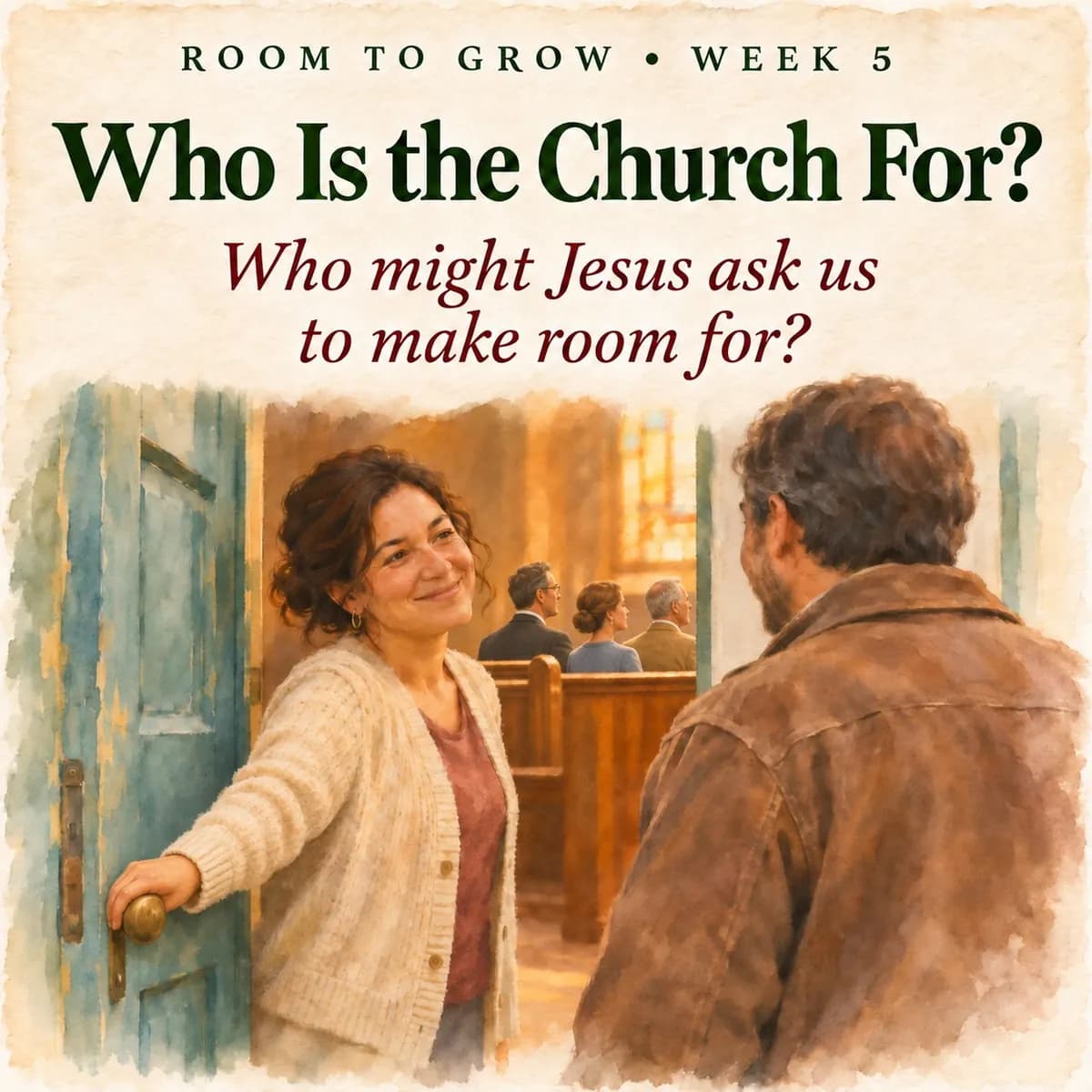
Room To Grow • A Tried & True Series
Week 5
Who Is the Church For?
By Trish Tipton
If you're joining me again, I'm guessing you're still searching too. I can't promise I'll find every answer, but this week's question is the heart of what I've been trying to say, so let's dive in. If I walked into one of the first churches, would I recognize its purpose in the people we make room for today?
Last time we looked at the shape of the gathering: one body, or a brand. I asked what Jesus thinks about unopened Bibles, about worship that can feel like a performance, and about talk of jewels in a crown and how many people we can lead to Christ. I want to go further now, because this is the heart of everything I've been trying to say.
The early church was about doing the work of Christ in the real sense of the word. It was not about getting people saved and building the numbers. If we were more about doing than building the salvation totals, those totals will build themselves.
I don't mean that salvation doesn't matter. It matters more than anything. I mean that the first believers didn't treat people as a count to be added up. They lived a certain way together, and then look what happened:
Acts 2:42-47 (NASB 2020)
42They were continually devoting themselves to the apostles’ teaching and to fellowship, to the breaking of bread and to prayer. 43Everyone kept feeling a sense of awe; and many wonders and signs were taking place through the apostles. 44And all the believers were together and had all things in common; 45and they would sell their property and possessions and share them with all, to the extent that anyone had need. 46Day by day continuing with one mind in the temple, and breaking bread from house to house, they were taking their meals together with gladness and sincerity of heart, 47praising God and having favor with all the people. And the Lord was adding to their number day by day those who were being saved.
They devoted themselves to the apostles' teaching, to fellowship, to the breaking of bread, and to prayer. They shared to the extent that anyone had need. They ate together with gladness. They praised God. And then this: "the Lord was adding to their number day by day those who were being saved."
He was adding. Day by day. They weren't building a total and calling it the work. They were doing the work, and He added.
I got a small taste of that years ago. About 40 years ago, our church had a visitation night. We'd go out into the neighborhoods close by and simply knock on doors and visit. One evening a friend and I called on a couple. In time they started coming to church, and later they were teaching a couples class. All we did was knock on a door and sit with them a while. God did the rest. I don't hear of many churches doing visitation like that anymore, and I miss it.
We sat with Acts 4 last time when we talked about how they gave. I don't want to repeat all of that. I just want us to remember what Luke said as they shared: there was not a needy person among them. The sharing and the adding belong together. A body that takes care of its own, and of the people in front of it, is a body the Lord can add to.
Jesus told us where He would be found, in one of the most searching pictures He ever gave:
Matthew 25:31-40 (NASB 2020)
31“But when the Son of Man comes in His glory, and all the angels with Him, then He will sit on His glorious throne. 32And all the nations will be gathered before Him; and He will separate them from one another, just as the shepherd separates the sheep from the goats; 33and He will put the sheep on His right, but the goats on the left. 34“Then the King will say to those on His right, ‘Come, you who are blessed of My Father, inherit the kingdom prepared for you from the foundation of the world. 35For I was hungry, and you gave Me something to eat; I was thirsty, and you gave Me something to drink; I was a stranger, and you invited Me in; 36naked, and you clothed Me; I was sick, and you visited Me; I was in prison, and you came to Me.’ 37Then the righteous will answer Him, ‘Lord, when did we see You hungry, and feed You, or thirsty, and give You something to drink? 38And when did we see You as a stranger, and invite You in, or naked, and clothe You? 39And when did we see You sick, or in prison, and come to You?’ 40And the King will answer and say to them, ‘Truly I say to you, to the extent that you did it for one of the least of these brothers or sisters of Mine, you did it for Me.’
"To the extent that you did it for one of the least of these brothers or sisters of Mine, you did it for Me." The hungry, the thirsty, the stranger, the naked, the sick, the prisoner. When they did it for them, they did it for Him.
He says the other side just as plainly. Those on His left are surprised too. They also say "Lord." They also ask when they saw Him in need and did not take care of Him:
Matthew 25:41-46 (NASB 2020)
41“Then He will also say to those on His left, ‘Depart from Me, you accursed people, into the eternal fire which has been prepared for the devil and his angels; 42for I was hungry, and you gave Me nothing to eat; I was thirsty, and you gave Me nothing to drink; 43I was a stranger, and you did not invite Me in; naked, and you did not clothe Me; sick, and in prison, and you did not visit Me.’ 44Then they themselves also will answer, ‘Lord, when did we see You hungry, or thirsty, or as a stranger, or naked, or sick, or in prison, and did not take care of You?’ 45Then He will answer them, ‘Truly I say to you, to the extent that you did not do it for one of the least of these, you did not do it for Me, either.’ 46These will go away into eternal punishment, but the righteous into eternal life.”
I don't want to turn that into a scare. I want us to hear what He tied to Himself: the person in need is where He said He would be. Doing the work of Christ, in the real sense of the word, looks like this.
There's another word I want to set beside that, without turning it into a whole other study. Gifts are what God does through a person. Fruit is what God grows inside a person:
Galatians 5:22-23 (NASB 2020)
22But the fruit of the Spirit is love, joy, peace, patience, kindness, goodness, faithfulness, 23gentleness, self-control; against such things there is no law.
A church can be very busy, and very gifted, and still miss the people Jesus named. Love, kindness, and gentleness are not a program. They're what the work looks like when it's real. Next time I want to sit with you on the warnings about looking right on the outside while something is missing on the inside. Today I just want us to stay with the work itself.
Jesus also told a man who had invited Him to dinner who should be on the guest list:
Luke 14:12-14 (NASB 2020)
12Now He also went on to say to the one who had invited Him, “Whenever you give a luncheon or a dinner, do not invite your friends, your brothers, your relatives, nor wealthy neighbors, otherwise they may also invite you to a meal in return, and that will be your repayment. 13But whenever you give a banquet, invite people who are poor, who have disabilities, who are limping, and people who are blind; 14and you will be blessed, since they do not have the means to repay you; for you will be repaid at the resurrection of the righteous.”
Invite the people who can't pay you back. Not the ones who will invite you to their nice house next week. The ones who will never be able to return the favor.
Years ago, at a Baptist church where I served in an affluent neighborhood, I saw a dirty, obviously homeless man turned away so the congregation wouldn't be offended. That was one of the first times I questioned what I had been taking as true. I still think about what he needed, and what he thought when the door closed.
I'm not telling that story to make that congregation into a villain. I was there. I was part of it. I understand that some people are afraid, especially when someone seems to be struggling with their mental health. We can be careful and still be kind. Food, shelter, and trained help matter. So does the bread of life. The way I see it, the hungry can't get well until they're fed the bread of life. I don't think a person should have to look well before we are willing to welcome them or feed them.
I've also seen people who appear homeless dropped off by someone in a nice car, and I've asked myself whether somebody was taking advantage of them. I don't know what was happening behind that door. If someone was exploiting them, that belongs on the person doing it, not on the hungry person who just wants food, or a way out of the cold or the heat. I don't want my suspicion about one person to close my heart to another.
Last time we read Deuteronomy 15, where God told Israel to fully open their hand, because the poor would not cease to exist in the land. Feeding people in need did not start with the church, and it did not end when the covenant changed. The first church took it so seriously that when some widows were being missed, they reorganized themselves:
Acts 6:1-4 (NASB 2020)
1Now at this time, as the disciples were increasing in number, a complaint developed on the part of the Hellenistic Jews against the native Hebrews, because their widows were being overlooked in the daily serving of food. 2So the twelve summoned the congregation of the disciples and said, “It is not desirable for us to neglect the word of God in order to serve tables. 3Instead, brothers and sisters, select from among you seven men of good reputation, full of the Spirit and of wisdom, whom we may put in charge of this task. 4But we will devote ourselves to prayer and to the ministry of the word.”
Their widows were being overlooked in the daily serving of food, and the apostles did not shrug it off. They set seven men of good reputation, full of the Spirit and of wisdom, over the task, so no widow would go unseen. The apostles kept praying and teaching, and they made sure the serving still got done. Feeding widows was important enough to organize the whole church around.
And when Paul met with James, Peter, and John, the leaders of the Jerusalem church, here is the one thing they asked of him:
Galatians 2:10 (NASB 2020), in part
10They only asked us to remember the poor
Paul adds that it was the very thing he also was eager to do. Of everything they could have asked, they asked him to remember the poor.
I'm thankful for every food bank and charity out there, and for every church that already feeds people. But I don't think the church should hand off what God put in our hands. If the church isn't feeding the hungry, somebody else will, and we will have missed one of the clearest things in the whole Book. And that includes me.
James called this something I had to sit with:
James 1:27 (NASB 2020)
27Pure and undefiled religion in the sight of our God and Father is this: to visit orphans and widows in their distress, and to keep oneself unstained by the world.
Pure religion: visit orphans and widows in their distress, and keep yourself unstained by the world. That's it. No mention of a building or a budget or a stage. "Visit" is a caring word. It means showing up. Going to them in their distress.
This is not a side project James invented. It's God's own character:
Deuteronomy 10:17-19 (NASB 2020)
17For the LORD your God is the God of gods and the Lord of lords, the great, the mighty, and the awesome God, who does not show partiality, nor take a bribe. 18He executes justice for the orphan and the widow, and shows His love for the stranger by giving him food and clothing. 19So show your love for the stranger, for you were strangers in the land of Egypt.
"He executes justice for the orphan and the widow, and shows His love for the stranger by giving him food and clothing." The great and awesome God, the Lord of lords, is the One who feeds the stranger and defends the widow. Then He tells His people to do the same.
That's why the stranger, the orphan, and the widow keep showing up together. They're the people with no one to stand up for them, and God says, I will.
Paul gave Timothy practical instructions for how the church should care for widows:
1 Timothy 5:3-5 (NASB 2020)
3Honor widows who are actually widows; 4but if any widow has children or grandchildren, they must first learn to show proper respect for their own family and to give back compensation to their parents; for this is acceptable in the sight of God. 5Now she who is actually a widow and has been left alone has set her hope on God, and she continues in requests and prayers night and day.
1 Timothy 5:8 (NASB 2020)
8But if anyone does not provide for his own, and especially for those of his household, he has denied the faith and is worse than an unbeliever.
1 Timothy 5:16 (NASB 2020)
16If any woman who is a believer has dependent widows, she must assist them and the church must not be burdened, so that it may assist those who are actually widows.
Honor the widow who is truly alone. Families, take care of your own, so the church can care for the ones who have no one. Paul doesn't give relatives permission to turn away and leave the church to do everything. I hear responsibility on both sides: families should help, and the church should see the person who has no one.
And what does God think about a divorced woman left alone, or someone whose grown children could help financially and don't? The way I read His heart in these verses, He stands up for them too. Divorce and widowhood aren't the same thing, but need is still need. Honestly, I have never personally seen a church care for women in those situations, so I don't have an example to offer. I wish I did. I'm not turning anyone's private life into a lesson. I'm saying I keep looking for that kind of care, and I have not seen it, and I think God sees the woman who has been left to figure it out alone.
Jesus warned religious leaders about something even harder to write down:
Mark 12:38-40 (NASB 2020)
38And in His teaching He was saying: “Beware of the scribes who like to walk around in long robes, and like personal greetings in the marketplaces, 39and seats of honor in the synagogues, and places of honor at banquets, 40who devour widows’ houses, and for appearance’s sake offer long prayers. These will receive all the more condemnation.”
"Who devour widows' houses, and for appearance's sake offer long prayers." If you look for that warning in Matthew 23:14 in the NASB 2020, you will not find a verse 14. The chapter goes from 13 to 15. Some older Bibles and some other translations print the line there. In this translation, the words are in Mark 12:40. I wanted to say that plainly, because I asked you to check the text with me, and I don't want anyone to think a verse went missing on purpose. The warning itself is not missing. Jesus said it.
God was not quiet about this in the Law either:
Exodus 22:22-24 (NASB 2020)
22You shall not oppress any widow or orphan. 23If you oppress him at all, and if he does cry out to Me, I will assuredly hear his cry; 24and My anger will be kindled, and I will kill you with the sword, and your wives shall become widows and your children fatherless.
"I will assuredly hear his cry." That one makes me tremble a little. God takes the treatment of widows and the people who have no protector personally.
I don't get to pretend I have lived this perfectly. I haven't. I do think this is what the church is for: doing the work of Christ among the people He named, and trusting Him with the totals.
Last time I asked whether we can see where a gift goes. Underneath that is another question. What was the purpose of your last gift, and of the work you call ministry? Did you picture it reaching a person in need?
We also looked last time at Jesus clearing the temple, because His Father's house had been turned into a place of business. I keep thinking about the other thing He was protecting: who the house was for. When He said, "It is written," one of the lines He was drawing from was this:
Isaiah 56:7 (NASB 2020)
7Even those I will bring to My holy mountain, And make them joyful in My house of prayer. Their burnt offerings and their sacrifices will be acceptable on My altar; For My house will be called a house of prayer for all the peoples.”
"A house of prayer for all the peoples." Not a house for the comfortable people already in the room. Not a house that has to be protected from a man who looks like he might offend someone. A house of prayer for all the peoples.
When I put all of this together, the drift comes into focus. It became easy to protect the comfort of the room, or to measure success by totals, instead of doing the work and letting Him add. That didn't happen overnight. It looks to me like a long, slow change in what we thought the church was for. I don't think most of it was done with a bad heart. People wanted a safe, orderly Sunday. They wanted to see lives changed and numbers that proved it. But the first churches shared, they ate together, they praised God, and the Lord was adding to their number day by day those who were being saved.
I'm not asking any of this to point a finger at your church, or at you. I had to start with a door I watched close, in a church I served. Many congregations already feed people, welcome strangers, and show up for widows, and I honor that. I can honor it and still say, the way I read it, if we were more about doing than building the salvation totals, those totals will build themselves.
I would rather you not take my word for any of this. Open your Bible and read it yourself. Read Acts 2 slowly, all the way through the sharing and the meals and the line about the Lord adding to their number day by day, and then look again at Acts 4 and Acts 6. Read Matthew 25, and sit with "you did it for Me." Read Luke 14, and see who Jesus put on the guest list. Read James 1, 1 Timothy 5, and Deuteronomy 10 and 15, and ask what pure religion looks like when it shows up at someone's door. Read Mark 12 and Exodus 22, and check Matthew 23 for yourself, so you can see where the warning about devouring widows' houses actually sits in this translation. Read Isaiah 56, and Matthew 21 beside John 2, and ask who the house of prayer is for.
If something doesn't sit right, stay with it. If a face comes to mind, a person you have walked past, or a door you have seen close, stay with that too. That's how this one started for me: a man turned away so nobody would be offended, and a growing sense that the church is for the work of Christ, and that if we did the work, He would take care of the adding.
Scripture quotations taken from the (NASB®) New American Standard Bible®, Copyright © 1960, 1971, 1977, 1995, 2020 by The Lockman Foundation. Used by permission. All rights reserved. lockman.org