
Room To Grow • A Tried & True Series
Week 4
One Body, or a Brand?
By Trish Tipton
If you're joining me again, it's because you're looking for answers too. I don't have them all, but I know the questions I'd like answered. Let's see what's on our list today. We've talked about the contract we're under, about the tithe, and about how the first churches gave. Now I want to look at the gathering itself. When we walk through the doors on a Sunday, are we gathering as the body of Christ, or building something that looks more like a franchise?
In the first week I said that Jesus made one new people in one body through the cross. I don't want to walk through all of that again. I keep coming back to it, though, because "the body" is not just a churchy word we use. Paul describes it as something living, with many parts and one life.
1 Corinthians 12:12-14 (NASB 2020)
12For just as the body is one and yet has many parts, and all the parts of the body, though they are many, are one body, so also is Christ. 13For by one Spirit we were all baptized into one body, whether Jews or Greeks, whether slaves or free, and we were all made to drink of one Spirit. 14For the body is not one part, but many.
1 Corinthians 12:27 (NASB 2020)
27Now you are Christ’s body, and individually parts of it.
One body. Many parts. Jews and Greeks, slaves and free, all made to drink of one Spirit. You are Christ's body, and individually parts of it. That is a long way from a crowd that happens to like the same brand.
Paul said it again to the Ephesians:
Ephesians 4:4-6 (NASB 2020)
4There is one body and one Spirit, just as you also were called in one hope of your calling; 5one Lord, one faith, one baptism, 6one God and Father of all who is over all and through all and in all.
One body. One Spirit. One hope. One Lord, one faith, one baptism, one God and Father of all.
And this is not only Paul. On the night before the cross, Jesus prayed for the people who would believe through the disciples' word. That's us. Here's what He asked:
John 17:20-23 (NASB 2020)
20“I am not asking on behalf of these alone, but also for those who believe in Me through their word, 21that they may all be one; just as You, Father, are in Me and I in You, that they also may be in Us, so that the world may believe that You sent Me. 22The glory which You have given Me I also have given to them, so that they may be one, just as We are one; 23I in them and You in Me, that they may be perfected in unity, so that the world may know that You sent Me, and You loved them, just as You loved Me.
"That they may all be one." Not so we would look impressive. "So that the world may believe that You sent Me." The way I read that, our unity is part of how the world is supposed to recognize Him. So when I look at the way we gather now, I have to ask a question I can't shake: what does Jesus think about all this?
Drive down almost any road in Tulsa and you'll pass church after church, sometimes right across the street from each other. Same Bible, same Jesus, and yet so many of them wouldn't share a pew. How did we get here?
I'd heard there were over 40,000 Christian denominations in the world, so I looked it up. The number is roughly right, with a big caveat. The Center for the Study of Global Christianity counts about 45,000 denominations worldwide. But it counts the same church separately in every country where it exists. The Catholic Church alone is counted once per country. So the number of truly distinct traditions is far smaller (Live Science; Center for the Study of Global Christianity). Even with that caveat, we are looking at a family that has split, and split again.
The first great split that historians point to came in 1054, when the church in the West, in Rome, and the church in the East, in Constantinople, separated. That is a long time ago. The dividing did not stop there.
Paul wrote to a church that had already started splitting into camps, and his words sound familiar:
1 Corinthians 1:10-13 (NASB 2020)
10Now I urge you, brothers and sisters, by the name of our Lord Jesus Christ, that you all agree and that there be no divisions among you, but that you be made complete in the same mind and in the same judgment. 11For I have been informed concerning you, my brothers and sisters, by Chloe’s people, that there are quarrels among you. 12Now I mean this, that each one of you is saying, “I am with Paul,” or “I am with Apollos,” or “I am with Cephas,” or “I am with Christ.” 13Has Christ been divided? Paul was not crucified for you, was he? Or were you baptized in the name of Paul?
"I am with Paul." "I am with Apollos." "I am with Cephas." Swap in the name of a denomination, or a well-known preacher, or a campus brand, and it sounds like today. And Paul asks, "Has Christ been divided?" The answer is no. We have.
I think a lot of the dividing comes back to pride. I don't want to be like you. I want to be unique. I need something different, a message of my own. Power and money are often underneath it, and it divides the body of Christ. I'm not saying every difference is wrong, or that we have to agree on everything. Some differences come from sincere people reading hard passages and landing in different places. But I think we ought to be able to sit in the same pew, pray together, and feed the hungry together, as one body.
There's another way the body can start to look like a brand, and it isn't only about denominations. It's about the shape of a Sunday. Think about the satellite campus model: as many locations as possible, and people turned over fast. Come in, you have an hour and a half, grab a coffee, grab a donut, sing some emotional songs, hear a couple of verses, and get out, because they've got to do it again. Pull in, get served, get out. Same menu at every location. It can feel like fast food. It can feel as if Christianity has been made into a product when it was never supposed to be one.
I'm not against big churches, or coffee, or good music. I'm not against anybody's donut, either. Faith just can't be fast food. It takes time. It takes people who know you. And it takes more than a couple of verses before everyone heads back to the parking lot.
Sometimes it seems as if half the people don't bring a Bible, and some who do never open it. That's my impression, not a number I've measured. I used to bring mine and then not open it again until the next Sunday's weekly feeding. I can't point a finger without remembering that. If the gathering becomes a place where we are fed a little and sent home until next week, we shouldn't be surprised when the Book stays closed the rest of the days.
I've also been in satellite worship that sounded more like a performance than worship to me. I'm not judging the singer's heart. I'm asking what we're there for. Worship isn't only a song. It's what we do, how we live, and whom we serve. A polished performance can still leave a room feeling cold and impersonal.
And sometimes the talk about jewels in your crown, and how many people we can lead to Christ, starts to sound like keeping score. Are there just not enough people willing to study the Word and share it in small groups? Is it greed, is it jewels, or have we forgotten the people right in front of us? I've noticed that a lot of people who lead someone to Christ don't stick around to show them the way. They point them to the book of John and walk away. Cha-ching, another jewel in the crown. It's no wonder so many new believers drift back to their old ways.
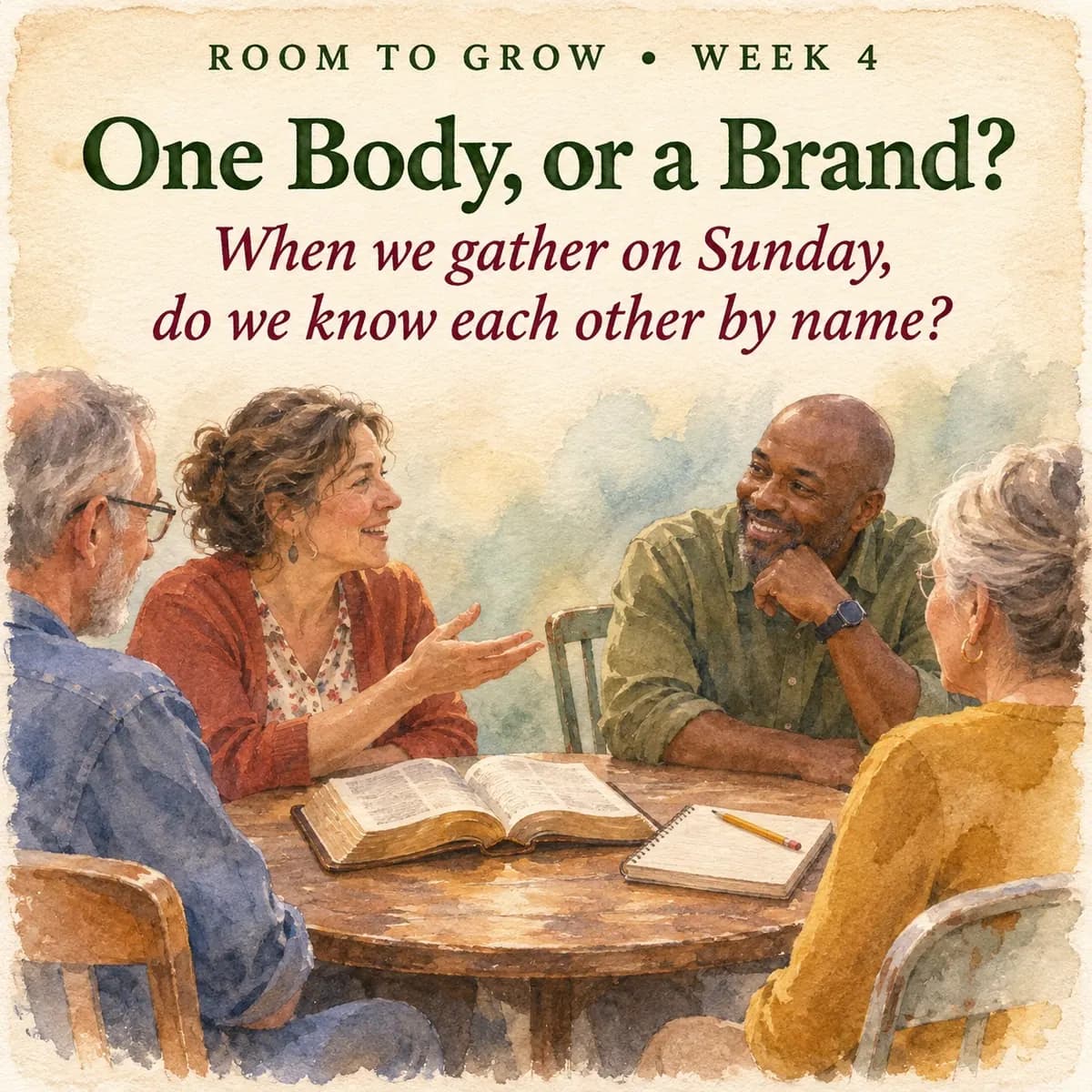
Another thing I noticed after I left the strict, dyed-in-the-wool Baptist church and visited a lot of other churches: many of the screen churches and nondenominational churches don't have Sunday school classes. The Baptists still have them, and maybe the Methodists, but I didn't find them in the nondenominational churches I visited. I'll be honest, not every Sunday school class had a good teacher, and I don't know why the classes started in the first place. Maybe for some churches they took the place of going out and serving. But at least it was more personal. You sat around a table with your Bible open, people knew your name, and you could ask questions. I want us to ask what Jesus thinks about that before we build another stage. There's more to say about doing the work itself, instead of building the totals, and I want to sit with you on that next time.
Paul said something about how the body is supposed to grow that I had to read slowly:
Ephesians 4:11-16 (NASB 2020)
11And He gave some as apostles, some as prophets, some as evangelists, some as pastors and teachers, 12for the equipping of the saints for the work of ministry, for the building up of the body of Christ; 13until we all attain to the unity of the faith, and of the knowledge of the Son of God, to a mature man, to the measure of the stature which belongs to the fullness of Christ. 14As a result, we are no longer to be children, tossed here and there by waves and carried about by every wind of doctrine, by the trickery of people, by craftiness in deceitful scheming; 15but speaking the truth in love, we are to grow up in all aspects into Him who is the head, that is, Christ, 16from whom the whole body, being fitted and held together by what every joint supplies, according to the proper working of each individual part, causes the growth of the body for the building up of itself in love.
He gave apostles, prophets, evangelists, pastors and teachers "for the equipping of the saints for the work of ministry, for the building up of the body of Christ." The saints do the work. The leaders equip them. The whole body grows as each part does its part, "for the building up of itself in love." That does not sound like an audience watching a few people on a platform. It sounds like a body in which nobody is only a customer.
Peter told the elders, the leaders of the church, how to lead:
1 Peter 5:2-3 (NASB 2020)
2shepherd the flock of God among you, exercising oversight, not under compulsion but voluntarily, according to the will of God; and not with greed but with eagerness; 3nor yet as domineering over those assigned to your care, but by proving to be examples to the flock.
"Shepherd the flock of God among you." Not manage the customers. Not grow the market share. Shepherd, which means knowing the sheep. "Not with greed but with eagerness," and "by proving to be examples to the flock," close enough for people to see how they live. A shepherd knows his sheep by name. It's hard to do that through a screen at a satellite campus.
Does the story of the tables in the temple belong here? I think it does. It isn't only about money, though money was in the courtyard. It's about what the house of God had been turned into.
John 2:13-16 (NASB 2020)
13The Passover of the Jews was near, and Jesus went up to Jerusalem. 14And within the temple grounds He found those who were selling oxen, sheep, and doves, and the money changers seated at their tables. 15And He made a whip of cords, and drove them all out of the temple area, with the sheep and the oxen; and He poured out the coins of the money changers and overturned their tables; 16and to those who were selling the doves He said, “Take these things away from here; stop making My Father’s house a place of business!”
"Stop making My Father's house a place of business." There were reasons for those tables on paper. People traveling to Jerusalem needed animals for sacrifice, and they needed their money changed. But the marketplace had taken over the place where people came to meet God. It's hard for me to read that and not think about how much of church life can be run like a business, with brands, growth targets, and locations.
I don't get to overturn anybody's tables. That was Jesus. But I can ask the question He was asking: is this a house of prayer, or a place of business? Is this a flock with shepherds who know them, or a crowd with a brand?
When I put all of this together, I can see that long, slow path again. The first believers were one body. Over a long stretch of years, about two thousand of them, one body became many brands, and shepherds could start to look like managers of a franchise. I don't think most of that was done with a bad heart. People wanted to reach more towns. They wanted excellence. They wanted a church that felt like home to their group. But a product that moves people in and out is not the same thing as a body that builds itself up in love.
I'm not asking any of this to point a finger at your church, or at you. I had to ask it of myself first. I sat through weekly feedings with a closed Bible in my lap. People who love the church they attend often have good reasons, and many shepherds are trying to know their people well. I can honor that and still say, the way I read it, Jesus prayed that we would be one, Paul asked whether Christ had been divided, and Peter told leaders to shepherd a flock, not manage a brand.
Where you gather, does it feel like one body following Jesus, or like a brand with His name on it?
I would rather you not take my word for any of this. Open your Bible and read it yourself. Read 1 Corinthians 12, and sit with what it means to be one body with many parts. Read Ephesians 4, and watch how the body is supposed to be equipped and built up. Read John 17 slowly, and listen to Jesus pray that we would be one so the world may believe. Read 1 Corinthians 1, and let Paul's question land: has Christ been divided? Read John 2, and ask what Jesus was protecting when He cleared the tables. Read 1 Peter 5, and see what a shepherd is supposed to be.
If something doesn't sit right, stay with it. If a Sunday starts to look different to you, stay with that too. That's how this one started for me: a feeling I couldn't name at first, like pulling through a line, getting served, and heading back out, and a growing sense that the body of Christ was never meant to be a franchise.
Sources: Live Science on Christian denominations (https://www.livescience.com/christianity-denominations.html); Center for the Study of Global Christianity, Gordon-Conwell, methodology (https://www.gordonconwell.edu/center-for-global-christianity/wp-content/uploads/sites/13/2020/08/dossier-methodology.pdf).
Scripture quotations taken from the (NASB®) New American Standard Bible®, Copyright © 1960, 1971, 1977, 1995, 2020 by The Lockman Foundation. Used by permission. All rights reserved. lockman.org