
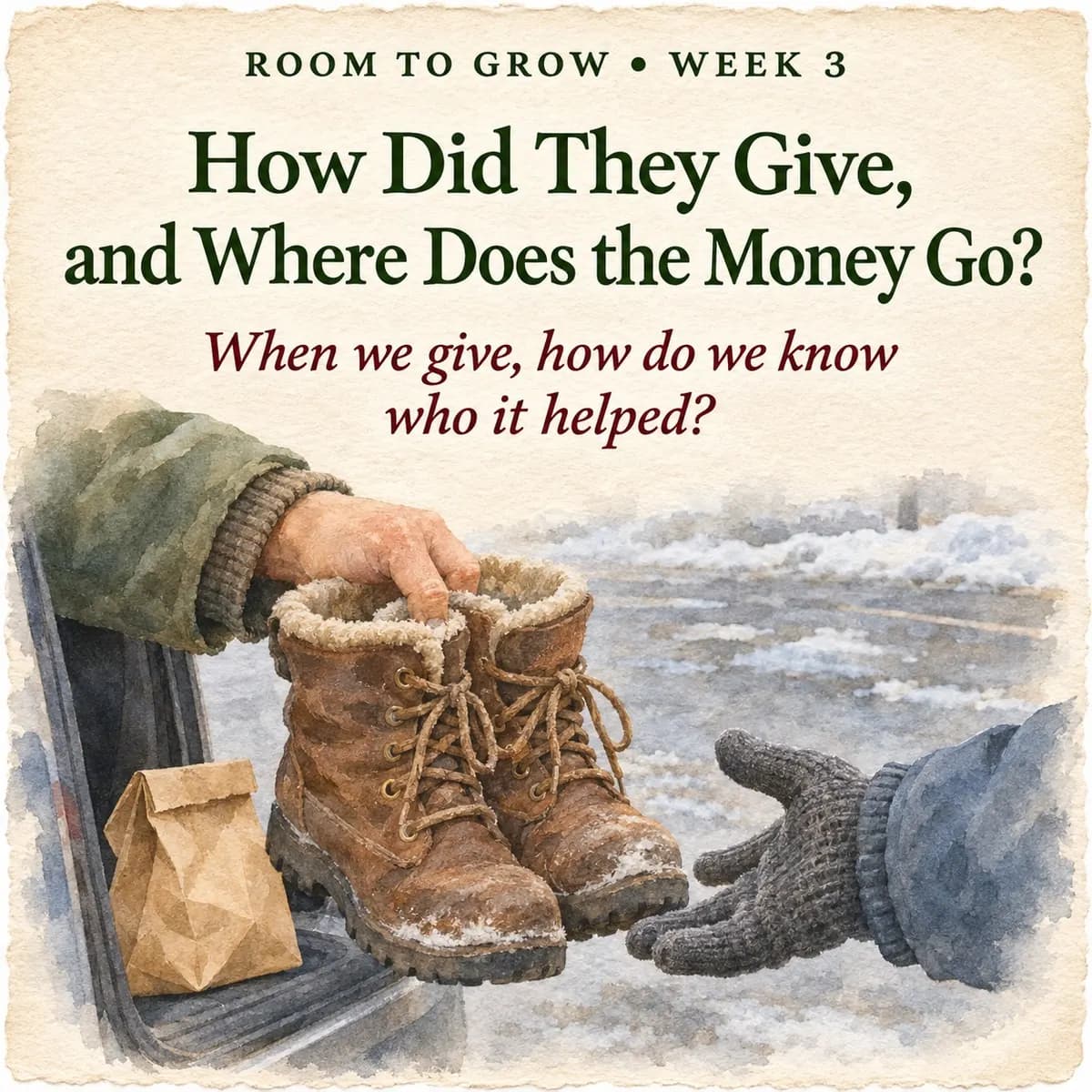
Room To Grow • A Tried & True Series
Week 3
How Did They Give, and Where Does the Money Go?
By Trish Tipton
If you've come again searching, let's search together. Last time we looked at the tithe, all of it, and I said that if seeing that set you free from the tithe as a law, I pray it doesn't set you free from giving. I meant that. Freedom from a percentage is not permission to close our hands. Cheerful, not absent.
The New Testament asks for a generous heart, not a fixed percentage. So I went looking for how the first churches actually gave, and then I had to ask the other half of the question: can we see where the gifts go?
Paul wrote to the church in Corinth about a collection they were gathering for believers in need. Here's what he told them:
2 Corinthians 9:6-7 (NASB 2020)
6Now I say this: the one who sows sparingly will also reap sparingly, and the one who sows generously will also reap generously. 7Each one must do just as he has decided in his heart, not reluctantly or under compulsion, for God loves a cheerful giver.
I keep coming back to "he has decided in his heart." Not as the church has decided for him. Not as the law requires. As he has decided in his heart. And then, "not reluctantly or under compulsion." Nobody is supposed to be pressured. God loves a cheerful giver.
Paul also gave them practical direction about that same collection:
1 Corinthians 16:1-2 (NASB 2020)
1Now concerning the collection for the saints, as I directed the churches of Galatia, so you are to do as well. 2On the first day of every week, each of you is to put aside and save as he may prosper, so that no collections need to be made when I come.
"As he may prosper." That's proportion, not a fixed percentage. Some weeks you have more, some weeks less. Put aside what you can, regularly, so it's ready when it's needed. Anybody who has ever run a household knows how that works.
Notice something else. Both passages are about a collection "for the saints," believers who were in need. Paul wasn't raising money for a building here. He was gathering help for people who were struggling.
He told the Corinthians about another group of churches that had already given to that same kind of need, the churches in Macedonia:
2 Corinthians 8:1-5 (NASB 2020)
1Now, brothers and sisters, we make known to you the grace of God which has been given in the churches of Macedonia, 2that in a great ordeal of affliction their abundance of joy and their deep poverty overflowed in the wealth of their liberality. 3For I testify that according to their ability, and beyond their ability, they gave voluntarily, 4begging us with much urging for the favor of participation in the support of the saints, 5and this, not as we had expected, but they first gave themselves to the Lord and to us by the will of God.
They gave voluntarily, "according to their ability, and beyond their ability," and they even begged to take part. They first gave themselves to the Lord. That's a long way from a required percentage. And then Paul explained how this kind of gift is measured:
2 Corinthians 8:12 (NASB 2020)
12For if the willingness is present, it is acceptable according to what a person has, not according to what he does not have.
"If the willingness is present, it is acceptable according to what a person has, not according to what he does not have." He went on to say this was not so others would have relief while they had hardship, but so there would be equality: your abundance helping someone else's need now, so that later their abundance can help you.
I know some people read all of this and feel relieved. Maybe they've quietly resented being told what to put in the plate, and now they think they won't have to feel guilty about keeping everything. I understand that feeling. But I'd gently say this: being free from the tithe isn't being free from giving. "God loves a cheerful giver." Cheerful, not absent. "The one who sows sparingly will also reap sparingly." Giving from the heart isn't an excuse to give nothing.
That same line, "not under compulsion," is why another story has stayed with me. I've heard about a commitment slip that a child, somewhere between 10 and 14 years old, brought home from a youth group. As it was described to me, it asked the child to commit for the next year: tithe 10 percent from an allowance, give part of birthday or Christmas money, earn money doing yard work, sell some electronics, take clothes to a resale shop, and give a portion of savings, then add it up and write down a total.
I wanted to know if that was real, so I looked. I couldn't find that exact slip, and I don't know where it came from. But a card that matches it almost line for line is posted publicly by Athens Church in Athens, Georgia. It's their "All In" student commitment card (Athens Church student card). It asks students to commit to give regularly for the next year. The options include giving some birthday or Christmas money, earning money specifically to give, selling belongings they don't use anymore, taking clothes to a resale shop, and giving a portion of savings. At the bottom, the student writes "my total one year commitment."
To be fair, I can't say this is the exact slip I heard about. The public card doesn't say "10 percent from your allowance," and it doesn't mention electronics. But it shows that cards like this are real, and that they're handed to students.
I keep thinking about what it feels like to be 12 years old, sitting in a youth group, and being handed a card to fill out in front of friends and leaders. I don't know how a child could say no to that freely. Children should be taught to be generous. Let them see a need and help meet it: a neighbor, a family that's struggling, a kid at school who doesn't have a coat. Let them feel the joy of that. A signed commitment with a total at the bottom teaches them that giving is an obligation to an institution. Jesus wanted children brought to Him, not to a pledge:
Mark 10:14 (NASB 2020)
14But when Jesus saw this, He was indignant and said to them, “Allow the children to come to Me; do not forbid them, for the kingdom of God belongs to such as these.
When I turn from those letters to the book of Acts, the picture gets even clearer. Right after Pentecost, here's how Luke describes the first believers in Jerusalem:
Acts 2:44-45 (NASB 2020)
44And all the believers were together and had all things in common; 45and they would sell their property and possessions and share them with all, to the extent that anyone had need.
"To the extent that anyone had need." That phrase keeps showing up. A couple of chapters later:
Acts 4:32-35 (NASB 2020)
32And the congregation of those who believed were of one heart and soul; and not one of them claimed that anything belonging to him was his own, but all things were common property to them. 33And with great power the apostles were giving testimony to the resurrection of the Lord Jesus, and abundant grace was upon them all. 34For there was not a needy person among them, for all who were owners of land or houses would sell them and bring the proceeds of the sales 35and lay them at the apostles’ feet, and they would be distributed to each to the extent that any had need.
"There was not a needy person among them." They brought what they had, and it was handed out to the extent that any had need. Can you imagine that being said about a church today? I'm not saying any of us, me included, have reached it. It's a high standard. But it's the one I see.
And it didn't stay in one city. When a prophet warned that famine was coming, the believers in Antioch did this:
Acts 11:27-30 (NASB 2020)
27Now at this time some prophets came down from Jerusalem to Antioch. 28One of them, named Agabus, stood up and indicated by the Spirit that there would definitely be a severe famine all over the world. And this took place in the reign of Claudius. 29And to the extent that any of the disciples had means, each of them determined to send a contribution for the relief of the brothers and sisters living in Judea. 30And they did this, sending it with Barnabas and Saul to the elders.
Each one gave "to the extent that any of the disciples had means." No set percentage. They sent it to brothers and sisters in another place who were going to be hungry. Later, Paul carried gifts the same way, from churches in Macedonia and Achaia to poor believers in Jerusalem. He said those churches "were pleased to do so."
Everywhere I looked, the pattern was the same. The money went to people. People in need, near and far.
I want to say this next part carefully, because it can be heard wrong. I don't mean the government should run everything. A free economy can lift people and nations out of poverty, and I'm grateful for that. But there are always people a market leaves behind, and the church belongs with them. The first believers held what they had loosely and shared as anyone had need, freely and out of love, as one body.
I also don't mean every believer must sell everything and live on the street. Acts tells us people sold property to meet needs, but it doesn't spell out where every one of them lived afterward. I don't want to fill that silence with a rule God didn't give. The harder question, for me, is this: what does not being tied to possessions look like when we still live in comfortable homes? Can I honestly say it's all God's if I won't let go of anything when someone else needs help? I think the question is whether I own the things, or the things own me.
Buildings and bills are a fact of life. I'm not saying a church shouldn't have a roof over its head. What I see in Acts is what giving was meant to be for: people, not institutions. When I give, I want to know it's reaching someone who needs it.
There's another side of this that matters just as much as the amount. Why do we give? I've heard people say that since they started giving a set amount religiously, they have been more blessed than ever. I don't doubt their hearts. But it can start to sound like paying for blessings, ten in and more back, more like an investment than a gift.
Jesus taught something very different:
Matthew 6:1-4 (NASB 2020)
1“Take care not to practice your righteousness in the sight of people, to be noticed by them; otherwise you have no reward with your Father who is in heaven. 2“So when you give to the poor, do not sound a trumpet before you, as the hypocrites do in the synagogues and on the streets, so that they will be praised by people. Truly I say to you, they have their reward in full. 3But when you give to the poor, do not let your left hand know what your right hand is doing, 4so that your charitable giving will be in secret; and your Father who sees what is done in secret will reward you.
The people who give to be seen "have their reward in full." They got what they were after: the praise. That's it. The one who gives in secret has a Father who sees.
We looked last time at a parable because of the tithe in it. I want to come back to it for another reason. Jesus told it to people who trusted in themselves that they were righteous:
Luke 18:9-14 (NASB 2020)
9Now He also told this parable to some people who trusted in themselves that they were righteous, and viewed others with contempt: 10“Two men went up into the temple to pray, one a Pharisee and the other a tax collector. 11The Pharisee stood and began praying this in regard to himself: ‘God, I thank You that I am not like other people: swindlers, crooked, adulterers, or even like this tax collector. 12I fast twice a week; I pay tithes of all that I get.’ 13But the tax collector, standing some distance away, was even unwilling to raise his eyes toward heaven, but was beating his chest, saying, ‘God, be merciful to me, the sinner!’ 14I tell you, this man went to his house justified rather than the other one; for everyone who exalts himself will be humbled, but the one who humbles himself will be exalted.”
"I pay tithes of all that I get." The Pharisee listed his giving to God like a receipt, as if God owed him something for it. And Jesus said he was the one who did not go home justified. The tax collector, who had nothing to brag about and only asked for mercy, did. Pride shouldn't be why we give. A gift is not a bargain, and it is not a way to put God in our debt.
Paul remembered Jesus saying this:
Acts 20:35 (NASB 2020)
35In everything I showed you that by working hard in this way you must help the weak and remember the words of the Lord Jesus, that He Himself said, ‘It is more blessed to give than to receive.’”
"More blessed to give than to receive." The blessing is in the giving itself. It isn't a payment that comes back later.
So when somebody asks me what the right amount is, I'd ask them the question back: what does your heart tell you? And then I'd ask them to pray about it before they answer. Find your own ways to give. For me, one of those ways is a pastor, teacher, and mighty man of God in Uganda. He tells me where the money goes without my having to ask. That shows me he's a good steward, and that he appreciates even the little I can send. I've also given umbrellas when it's raining and blankets when it's cold. I even gave the snow boots I was wearing, and the rest of my breakfast, to a person without shoes in a grocery store parking lot. Then I had to go home for other shoes so I could finish my errands.
I don't usually talk about that, and I'm only mentioning it so you'll know where I'm coming from. Not to be blessed myself, and not so anyone will notice. For you it might be a neighbor, a widow down the street, or a ministry you've looked into and trust. Just give, and give cheerfully, to the people God puts in front of you.
That pastor in Uganda telling me where the money goes, without being asked, is part of why I trust him. It also sent me back to Paul. When Paul carried a gift from the churches to poor believers in Jerusalem, here's how careful he was:
2 Corinthians 8:20-21 (NASB 2020)
20taking precaution so that no one will discredit us in our administration of this generous gift; 21for we have regard for what is honorable, not only in the sight of the Lord, but also in the sight of other people.
He made sure no one could question how the gift was handled, "not only in the sight of the Lord, but also in the sight of other people." He didn't say, "God knows my heart, so you don't need to see the books." He went out of his way so everyone could see the money got where it was supposed to go.
Jesus said something that fits right beside that:
Luke 16:10-11 (NASB 2020)
10“The one who is faithful in a very little thing is also faithful in much; and the one who is unrighteous in a very little thing is also unrighteous in much. 11Therefore if you have not been faithful in the use of unrighteous wealth, who will entrust the true wealth to you?
Faithful in little, faithful in much. If that's the standard, then how a church handles every dollar matters, not just the big picture.
And this, about where we keep our treasure:
Matthew 6:19-21 (NASB 2020)
19“Do not store up for yourselves treasures on earth, where moth and rust destroy, and where thieves break in and steal. 20But store up for yourselves treasures in heaven, where neither moth nor rust destroys, and where thieves do not break in or steal; 21for where your treasure is, there your heart will be also.
"Where your treasure is, there your heart will be also." That's true for a person, and the way I read it, it's true for a church too. Look at where the money goes and you'll see what it really loves.
Here is a question I think we should be free to ask: "If I give, can I choose where it goes, and will you show me it got there?" A designated gift ought to mean something. If the church cannot use it that way, I would rather it tell me before it accepts the money.
Asking isn't a lack of faith. It's what Paul modeled. Does your church show you where its money goes? If not, maybe ask yourself why. I'm not assuming every church hides its books. Many congregations already open them, and I honor that. Independence, though, ought not to mean freedom from accountability. When a church answers to no one, who checks the money?
Part of why that question is hard to answer is a reporting rule most people never hear about. The IRS says churches generally do not have to file Form 990, the yearly report most other nonprofits file (IRS Publication 1828). That explains why you often cannot look up a church the way you would look up a charity. It doesn't prove anyone is doing something wrong. But it does mean that if the church itself doesn't show its people the books, there may be no outside report to read.
I want to look at one church that has already been in the public record, not to turn it into the villain of this story, and not because I think every church looks like this. I looked because the figures and the questions are already out in the open, and they help me ask a fairer question of any place we give. I'm telling this once, as a public window, and I want the church's own words heard too.
The church is the Church of Eleven22 in Jacksonville, Florida. Its thrift store, Hope's Closet Thrift, says on its own website that it "is a ministry of The Church of Eleven22" (Hope's Closet). A news report from the Roys Report says the store has "millions in sales each year" (Roys Report). Because it identifies itself as part of the church, and churches don't have to file a 990, a public yearly report is not something you can just look up.
To be fair, the church describes Hope's Closet as a ministry that "offers affordable goods in a dignified retail setting and supports community programs and ministry partners" (the church's own FAQ). That explanation should be heard. I'm not against a church running a store, and I know many thrift stores do real good. What I keep coming back to is what donors expected to happen to their gifts. When people donate clothes to a church, most of them picture those clothes going to someone who needs them. Next time you drop off a bag, it's fair to ask where it's going, and what the purpose of your giving was. People shouldn't donate blindly.
Jesus told His disciples:
Matthew 10:8 (NASB 2020)
8Heal the sick, raise the dead, cleanse those with leprosy, cast out demons. Freely you received, freely give.
"Freely you received, freely give." If clothes are given to a church for free, it seems to me they ought to go out for free to people in need. If they are sold to support ministry, the people who gave them deserve a clear look at where the proceeds went.
The same public record raises two other questions I don't want to scatter across different weeks.
In 2020, Small Business Administration data shows a PPP loan of $1,730,965 approved for the church on April 7. It was forgiven on June 24, 2021, for $1,749,669.04, which includes interest (PPP loan data). The church confirms it received the loan and that it was forgiven (church FAQ). That same year, in October 2020, the church bought the 3,217-acre Cabin Bluff property in Georgia for $12.75 million (Open Space Institute). The church calls it a Retreat Center, used for retreats and ministry events. It says the PPP money paid staff salaries for the church and its thrift store, that the Retreat Center "was purchased in 2020 and financed separately," and that both were reviewed by its outside auditors (church FAQ).
To be fair, the Roys Report found that the government forgave 95 percent of the PPP loans to religious organizations it examined. Lots of churches took these loans (Roys Report). Taking the loan was legal, and forgiveness followed the program's rules. I remember 2020, and how scared small businesses were. My question is simply whether it is Christlike for a church that could make a purchase like that in the same year to ask taxpayers to cover its payroll. The church says the money was kept separate, and I'm taking them at their word that the PPP funds paid salaries. I still think it's a fair question.
According to the Roys Report, a 2026 documentary said Eleven22 reported $91.1 million in revenue and $176.3 million in assets in 2025, figures the film presents as coming from the church's own financial disclosures (Roys Report). I had also heard that members get a single sheet with three pie charts, and that about 27 percent goes to salaries. I couldn't confirm the pie charts or the 27 percent.
To be fair, here's what the church says on its own website. Its elder board approves the yearly budget, including total staff pay. The lead pastor's pay is set by elders who aren't on staff. The church is audited every year by an independent accounting firm, and the audit is summarized in an annual report. But it says plainly, "We do not disclose individual employee compensation" (the church's FAQ). I'm glad it is audited, and I'm glad it says so. That counts for something. The Roys Report also says, citing the documentary, that the church resigned from the Evangelical Council for Financial Accountability, a watchdog group for Christian ministries, in February 2026. When the Roys Report asked the church to comment on the film, it replied, "We don't make a practice of commenting on YouTube videos publicly" (Roys Report).
I'm not saying anyone at that church is a crook. I don't know that, and I won't say it. I'm saying the people who give the money deserve to see where it goes, in real detail, because that is what Paul meant by having regard for what is honorable in the sight of other people.
When I think about a reasonable way to support the people who teach us, I keep coming back to Paul. He had a trade as well as a calling:
Acts 18:3 (NASB 2020)
3and because he was of the same trade he stayed with them, and they worked together, for they were tent-makers by trade.
Acts 20:34 (NASB 2020)
34You yourselves know that these hands served my own needs and the men who were with me.
He worked to meet his own needs and those of the men with him. That makes me ask why a bivocational pastor, someone who works another job, or a part-time pastor should be treated as second best. A smaller church can still be a real church without carrying a salary it cannot afford.
I don't want to leave out the other side of what Paul wrote:
1 Corinthians 9:14 (NASB 2020)
14So also the Lord directed those who proclaim the gospel to get their living from the gospel.
Philippians 4:15-16 (NASB 2020)
15You yourselves also know, Philippians, that at the first preaching of the gospel, after I left Macedonia, no church shared with me in the matter of giving and receiving except you alone; 16for even in Thessalonica you sent a gift more than once for my needs.
Paul accepted help too. The church in Philippi sent him a gift more than once for his needs. I don't read these passages as a ban on paying pastors. I see room for a paid ministry and room for working with your own hands. What I question is treating an expensive full-time position as the only faithful way to lead.
There's one more place this question about money goes, and it isn't only about one congregation. When is saving wise, and when is it hoarding? The Bible praises the person who plans ahead. Jesus also told a story about a man who built bigger and bigger barns.
Joseph stored up grain in Egypt for a famine, and he said why:
Genesis 41:35-36 (NASB 2020)
35Then have them collect all the food of these good years that are coming, and store up the grain for food in the cities under Pharaoh’s authority, and have them guard it. 36Let the food be used as a reserve for the land for the seven years of famine which will occur in the land of Egypt, so that the land will not perish during the famine.”
And when the famine came:
Genesis 41:56 (NASB 2020)
56When the famine was spread over the entire face of the earth, then Joseph opened all the storehouses and sold grain to the Egyptians; and the famine was severe in the land of Egypt.
"Joseph opened all the storehouses." He saved for a purpose, and when the need came, the storehouses opened.
Now here's the story Jesus told:
Luke 12:16-21 (NASB 2020)
16And He told them a parable, saying, “The land of a rich man was very productive. 17And he began thinking to himself, saying, ‘What shall I do, since I have no place to store my crops?’ 18And he said, ‘This is what I will do: I will tear down my barns and build larger ones, and I will store all my grain and my goods there. 19And I will say to myself, “You have many goods stored up for many years to come; relax, eat, drink, and enjoy yourself!”’ 20But God said to him, ‘You fool! This very night your soul is demanded of you; and as for all that you have prepared, who will own it now?’ 21Such is the one who stores up treasure for himself, and is not rich in relation to God.”
This man's barns never opened. He just kept building bigger ones. "Not rich in relation to God."
And the Law told Israel what to do when a neighbor was in need:
Deuteronomy 15:7-8, 11 (NASB 2020)
7“If there is a poor person among you, one of your brothers, in any of your towns in your land which the LORD your God is giving you, you shall not harden your heart, nor close your hand from your poor brother; 8but you shall fully open your hand to him, and generously lend him enough for his need in whatever he lacks. 11For the poor will not cease to exist in the land; therefore I am commanding you, saying, ‘You shall fully open your hand to your brother, to your needy and poor in your land.’
"Fully open your hand." There will always be people in need. That's what a storehouse is for.
I've looked at outside estimates of the wealth held by the Church of Jesus Christ of Latter-day Saints, the LDS church. The church doesn't publish its finances, so these figures are not its own report. The Widow's Mite Report estimates about $321 billion in total assets at the end of 2025, and it says the reserves could fund church programs indefinitely (Widow's Mite Report). Other public pieces of that picture include about $56.6 billion in U.S. stocks reported by the church's fund, Ensign Peak Advisors, on its required SEC filing at the end of 2025 (Ensign Peak 13F; Salt Lake Tribune). And yet it still asks its members for 10 percent a year.
I'm not writing this to attack my LDS neighbors. I'm sure many of them are generous, faithful people. My question is for the institution, and honestly, it's the same question I'd ask any church with a storehouse that never opens. Saving is wise when it has a purpose and the door opens when the need comes, like Joseph's. It becomes something else when the barns just keep getting bigger.
And we can't take any of it with us when we die. That goes for a church's leaders as much as it does for the rest of us. If the storehouse never opens, what good did holding on to all of it do?
I also think about how small amounts add up. A little rounding on a cash purchase. A utility increase in Oklahoma of a little over two percent. Each may sound too small to worry about until we keep paying it. I'm not putting a total on either one. I'm saying that small doesn't mean it doesn't matter, whether we're talking about what we give or about what an institution keeps.
When I put all of this together, I can see that long, slow path again. Giving among the first believers started as a glad decision toward a need they could see. Over a long stretch of years it became easier to treat giving as pledged support of an institution, and the details of where it went got thinner. I don't think most of that was done with a bad heart. A church has bills. People want to help. But a percentage without a need you can see, and without a clear account of where it went, doesn't look like what I read in Acts or in Paul's letters.
I'm not asking any of this to point a finger at your church, or at you. I had to ask it of myself first. Pastors who teach giving a certain way often inherited that teaching, and many of them are trying to be faithful with what they were given. People who give regularly often do it out of love for God. I can honor that and still say, the way I read it, the New Testament asks for a generous heart, not a fixed percentage, and for gifts that can be seen to reach a real need.
What would change if you gave as you decided in your heart, to a real need you can see, and if you knew where it went?
I would rather you not take my word for any of this. Open your Bible and read it yourself. Read 2 Corinthians 8 and 9, and 1 Corinthians 16, and watch for a cheerful decision, in proportion to what a person has, for people in need. Read Acts 2, 4, and 11, and see how they shared so that there was not a needy person among them, and how they sent help when famine was coming. Read Matthew 6, and sit with giving in secret and with where your treasure is. Read Luke 18 again, not only for the tithe, but for the pride that can hide inside a gift. Read Luke 12 and 16, Genesis 41, and Deuteronomy 15, and ask when a storehouse is wise and when a barn has stayed closed too long. Read Acts 18 and 20, 1 Corinthians 9, and Philippians 4, and see both sides of how Paul lived and how the churches cared for him. Read Mark 10, and remember who Jesus wanted the children brought to.
If something doesn't sit right, stay with it. If a question about your own giving opens up, stay with that too. That's how this one started for me: a hope that freedom from the tithe would not become freedom from giving, and a growing sense that I needed to know how they actually gave, and whether we can still see where the gifts go.
Sources: Athens Church, "All In" student commitment card (https://athenschurch.com/content/general/AllIn/Downloads/AllIn-CommitmentCard-Students-nobleed.pdf); IRS Publication 1828, Tax Guide for Churches and Religious Organizations (https://www.irs.gov/pub/irs-pdf/p1828.pdf); Roys Report, Oct 21, 2026 (https://roysreport.com/new-film-questions-eleven22-churchs-forgiven-1-73m-ppp-loan-retreat-property-and-pastors-lifestyle/); The Church of Eleven22, "FAQ: Stewardship and Governance" (https://coe22.com/stewardship); Hope's Closet Thrift, "About" (https://www.hopesclosetthrift.com/about); SBA loan data via PPP Report (https://pppreport.org/latest/company/church+of+eleven22+inc); Open Space Institute on the Cabin Bluff sale (https://www.openspaceinstitute.org/news/the-nature-conservancy-and-open-space-institute-move-historic-cabin-bluff-property-closer-to-permanent-protection-with-sale-of-waterfront-compound-to-florida-church); The Widow's Mite Report, 2025 update (https://thewidowsmite.org/2025update/); Salt Lake Tribune, Aug 16, 2025 (https://www.sltrib.com/religion/2025/08/16/lds-church-stock-portfolio-hits/); Ensign Peak Advisors SEC Form 13F (https://www.sec.gov/Archives/edgar/data/1454984/0001454984-26-000002.txt). The LDS church does not publish its finances, so those figures are outside estimates.
Scripture quotations taken from the (NASB®) New American Standard Bible®, Copyright © 1960, 1971, 1977, 1995, 2020 by The Lockman Foundation. Used by permission. All rights reserved. lockman.org